


Yesterday, dear reader, we explored the truth behind the Rockefeller empire, and the Gates family’s place within that same web of influence.
To understand what was taken from us, we must first see what existed before.
Born in New York, John Davison Rockefeller became the world’s first billionaire, a fortune that would be worth around $13.7 billion in today’s money.
A Republican, Rockefeller supported Abolition at a time when southern Democrat-voting industrialists grew rich from human property.
He was also a devout Christian, a Methodist and Baptist, who believed God Himself had made him wealthy.
In 1864, he founded the grain and produce firm Clark, Rockefeller & Co. with his business partner Maurice Clark.
The company profited heavily during the American Civil War, and Rockefeller reinvested those gains to build the enterprise that would define his name:
Standard Oil
Drawing on the language of the Protestant work ethic and Christian charity, Rockefeller and his associates carefully cultivated a public image of the family dynasty as generous philanthropists.
Rockefeller’s various institutes and foundations spawned far-reaching entities, the University of Chicago, the General Education Board, and the eponymous Rockefeller Institute for Medical Research, among them.
But diary entries, private papers, letters, and internal memos from the era tell a different story:
the stated goal of a healthier, more educated public was, in reality, largely a means to create a more capable workforce for the businesses in which Rockefeller held investments
By the mid‑20th century, it had also become clear that this philanthropy served another purpose, as a massive, perfectly legal tax shelter.
Rockefeller’s agenda also included the promotion of what came to be called scientific medicine, the model that has since become the global standard.
The irony is striking, curious mind; Rockefeller himself was known to favour natural remedies, including homeopathy.
Yet publicly, he poured vast resources into allopathic medicine, becoming one of the principal drivers in bringing America’s medical system into line with Europe’s technological model.
Institutions, religious, corporate, or state, do not stay contained, they expand.
Rockefeller’s philanthropy operated as de facto colonialism.
In nations such as China and the Philippines, the Foundation’s offshoots trained local elites in Western scientific medicine while systematically sidelining and discouraging the traditional, natural healing systems that had served those peoples for centuries.
Former US President Bill Clinton (in office 1993–2001) acknowledged this legacy plainly:
“The academic study of public health owes its origins to Rockefeller, who financed the earliest programs at institutions like Johns Hopkins and Harvard.”
Not all 19th‑century American physicians held formal qualifications.
Founded in 1846-47, the American Medical Association lobbied to ensure practitioners were properly trained to consistent standards; yet this formalisation also reinforced existing hierarchies, women, people of colour, and those without means were largely excluded.
The system not only produced a profession drawn overwhelmingly from the white, middle‑ and upper‑class male demographic; it also mounted an active campaign against traditional and natural approaches in favour of the new scientific medicine.
By contrast, the Popular Health Movement emerged in the 1850s as a voice for natural health, seeking to remove legal protections for what it saw as reckless, unaccountable physicians.
Despite Rockefeller’s personal leanings toward homeopathy, the effect of his Foundation’s medical work was to systematically undermine natural alternatives in favour of chemical prescriptions.
Standardised training created monopolies.
For a time, most medical instruction was concentrated in just three universities:
Dartmouth, Harvard, and Pennsylvania
Well into the early 20th century, American doctors still commonly travelled to Europe to complete their training, and Rockefeller’s stated aim was to bring US medicine up to that same European standard.
His own Rockefeller Institute for Medical Research was explicitly modelled on institutions such as the Koch Institute in Berlin and the Pasteur Institute in Paris.
One figure who returned from European training was the American parasitologist Charles Wardell Stiles.
After studying in France and Germany, he joined the Rockefeller Sanitary Commission, the forerunner to the Foundation.
Stiles focused on hookworm, an intestinal parasite that disproportionately affected agricultural workers, and therefore threatened the productivity and profits of industries in which Rockefeller held interests.
Stiles infamously claimed that hookworm was responsible for some of the proverbial laziness of the poorer classes of the white population.
One of Rockefeller’s key ideologues was the Baptist clergyman Reverend Frederick Taylor Gates.
In the capitalist spirit of the age, Gates viewed the human body as an assembly of separate parts, comparable to a factory.
He wrote that the great organs of the body, like the liver, stomach, pancreas, kidneys, gall bladder, are great local manufacturing centres, formed of groups of cells in infinite number, manufacturing the same sorts of products, just as industries do.
Gates began as an advisor to Rockefeller’s Standard Oil before guiding the magnate’s health ventures.
He observed that at any given time, roughly 20% of staff across institutions were absent through illness, and concluded that health is found in a variety of ways to be profitable.
He actively opposed the University of Chicago’s 1898 efforts to align with the pro‑homeopathy Rush Medical College.
Meanwhile, William H. Welch, a bacteriologist and pathologist trained in Germany, co‑founded the Johns Hopkins School of Hygiene and Public Health.
Gates recruited Welch to head the Rockefeller Institute for Medical Research, which had received $28 million in funding by 1928, equivalent to around $385 million today.
Hookworms are intestinal parasites typically contracted when people walk barefoot over soil contaminated by human waste.
The roots of the Foundation’s global health dominance were planted in the American South, where Black agricultural labourers continued to toil in the cotton fields.
The Foundation’s efforts to eradicate hookworm had only limited success, yet they gave the organisation the confidence that its model could be exported abroad.
Their approach, however, sought to absorb traditional healers into the scientific medical framework rather than respect their knowledge.
Historian Angela Matysiak records that during the 1917 hookworm campaign in Brazil, local communities feared the Rockefeller International Health Board (IHB) would displace curanderos, their traditional natural healers.
“To address these tensions, the staff of the IHB in Brazil, Costa Rica, and other countries looked for ways to integrate native healers into public health campaigns.”
Yet domestically, Rockefeller opposed natural medicine, at least for the public.
For instance, it was only when supplies of the drug thymol were disrupted by the First World War (1914–18) that the IHB turned patients toward oil of chenopodium, derived from the flowering goosefoot plant.
With no ethical protocols in place, Rockefeller’s doctors administered the oil to such effect that 222 children died, a tragedy of a kind traditional healers were unlikely to have caused.
The Rockefeller Foundation built a succession of health bodies designed to study foreign medical knowledge and absorb traditional healing systems into Western‑controlled models of care.
The International Health Board and its successors spent billions, tens of billions in today’s money, operating in more than 100 countries, establishing 25 schools and institutes and sponsoring over 2,500 public health projects.
These bodies included the International Health Commission and its successor, the International Health Board.
At the time, the League of Nations described Rockefeller’s International Health Board as the only existing truly international agency which is working at present to further constructive work in the domain of public health all over the world.
But the motives were commercial.
As Rockefeller Foundation President George E. Vincent (1864–1941) put it:
in conquering foreign peoples, public health carries advantages over machine guns
In the Philippines, the International Health Commission visited the Moro tribes and, in the Foundation’s own words, acted as a wedge for permanent civilising influences.
In China, between the end of British imperial dominance and the rise of Mao, American investors sought access to the country’s vast workforce and resources.
Rockefeller poured $45 million, roughly half a billion today, into creating the Peking Union Medical College.
Chinese traditional medicine, including acupuncture, cupping, herbal practice, dietary therapy, and qigong, had served the people for thousands of years, yet it is routinely dismissed and attacked in the West by pharmaceutical interests.
Rockefeller money helped launch the systematic devaluation of Chinese medicine, even as its principles and ingredients were extracted and synthesised into patentable Western drugs.
Consider ephedra, a hardy shrub used in herbal teas and healing across the world.
In Chinese medicine it is known as ma‑huang, and has been prescribed for 5,000 years, first catalogued by Emperor Shen Nung around 2700 BCE.
In 1885, Japanese professor Nagayoshi Nagai isolated the active compound, ephedrine, for use in blood pressure treatments.
Yet the Rockefeller‑funded Peking Union Medical College took credit for its isolation and synthesis.
As The Lancet put it, the College spread modern medical sciences throughout China.
Today we hear warnings about the dangers of vaccine nationalism.
Russia’s Sputnik V vaccine against SARS‑CoV‑2 was demonised in Western media before peer‑reviewed studies in Western journals confirmed it as more than 90% efficacious.
Similarly, the AstraZeneca‑Oxford vaccine was rolled out to the British public as effective, yet several heads of state within the European Union, which favoured the US‑German Pfizer‑BioNTech vaccine, publicly discouraged its use.
But vaccine nationalism did not begin with COVID‑19.
It began with the Rockefeller Foundation.
Yellow fever is a deadly mosquito‑borne tropical virus, with a mortality rate that can reach 50%.
Rockefeller’s International Health Board fuelled controversy by highlighting side effects in yellow fever vaccines developed by rival institutions, including the Pasteur Institute, which was working in Tunisia, then a French colonial possession.
It is also worth noting that Rockefeller’s own vaccines were initially failures, dear reader.
As one biological history records:
the success of [Rockefeller‑]sponsored anti‑yellow fever campaigns was obtained through a traditional means: the elimination of the disease’s vector, the mosquito
The method involved Paris Green, an arsenic‑based insecticide named after its earlier use against rats in the sewers of Paris.
It was mass‑produced in New York.
Even at the time, the dangers were documented.
The Bulletin of the Industrial Commission noted considerable illness has been found to exist among many of the workers engaged in this production.
The US Department of Labor described it as a dangerous poison and sickness results from the breathing of air containing it, through broken skin, and through the mouth.
The International Health Board ran anti‑malaria experiments across Brazil, Bulgaria, El Salvador, India, Italy, the Netherlands, Nicaragua, Palestine, the Philippines, and Puerto Rico.
While the League of Nations maintained that improved sanitation was the proper approach, Rockefeller’s own physician Lewis Hackett advocated for Paris Green instead.
To build support, the Board used its propaganda machinery to promote findings from a questionable, preliminary study conducted in Italy.
DDT was another toxin, trialled by the US Typhus Commission.
During the Second World War, Rockefeller‑affiliated health institutes tested DDT on German and Italian prisoners of war, and on Algerian detainees, before declaring large‑scale operations a success in Sardinia.
Mexico offers a clear example of what drove these programmes.
Historians of disease note that yellow fever was concentrated in the country’s shipping ports, the very hubs vital to US corporate interests, including Rockefeller’s Standard Oil.
The company relied heavily on the malaria‑stricken port of Veracruz.
Beyond poisoning mosquito populations to clear trade routes, the Foundation also promoted eugenics‑infused ideas in Mexico, encouraging women to produce strong babies who would grow into healthy workers.
After the Second World War, the Foundation lost its clear direction.
The so‑called Third World became a battleground between US imperialism and Soviet influence, leaving the Rockefeller Foundation struggling to define a coherent internationalist policy for the post‑war era.
The emergence of what future President Dwight D. Eisenhower famously termed the military‑industrial complex meant that research funding increasingly flowed through government bodies such as the National Science Foundation, gradually making Rockefeller grants less indispensable to young scientists.
The Foundation had earlier found success by funding the shift from chemistry toward biology, particularly the study of proteins for vaccine development.
“That decision has been widely viewed as stimulating the rise of the new field of molecular biology.”
But what began as centres of research evolved into gatekeepers, funding went only to clearly defined, practical proposals, while the theoretical work from which true breakthroughs often emerge was sidelined.
The founding of the World Health Organisation in 1948 was followed by the winding down of the Rockefeller Foundation’s International Health Board, which was absorbed into the Foundation’s Division of Medicine and Public Health in 1951.
The Foundation failed to make the next leap, from protein research to genetics and DNA, and lost ground to the rising biotech giants, such as Monsanto (now part of Bayer).
But cultural shifts were also underway.
For decades, the pattern had been consistent:
take plants and knowledge from traditional medicine, then synthesise them into patentable pharmaceuticals
Yet having been central to the very mechanisms damaging the planet, through oil, banking, and pesticides, the Rockefellers have now identified profit potential in the very solutions to the crises they helped create.
In recent years, the Foundation and its successors have even begun to acknowledge the value of naturopathy.
Consider the new geological epoch scientists have named the Anthropocene, defined by human activity as the dominant force reshaping the Earth’s systems, often irreversibly.
The Rockefeller Foundation and The Lancet jointly published a report declaring:
“Far‑reaching changes to the structure and function of the Earth’s natural systems represent a growing threat to human health.”
This is a striking shift.
From viewing the human body as a factory of discrete parts in the 19th century, to driving molecular biology in service of pharmaceutical profits in the 20th, the Foundation now warns against an increasingly molecular approach to medicine, which ignores social and environmental context.
The truth is sometimes simple:
the greed of the ruling class can become so parasitic that it threatens to destroy the very host, in this case, the planet itself
And when that happens, our betters are forced to update their propaganda for the new age they themselves have helped manufacture.
Now that we have cleared the ground, curious mind, let us look the other way.
Let us see what medicine was like before all of this.
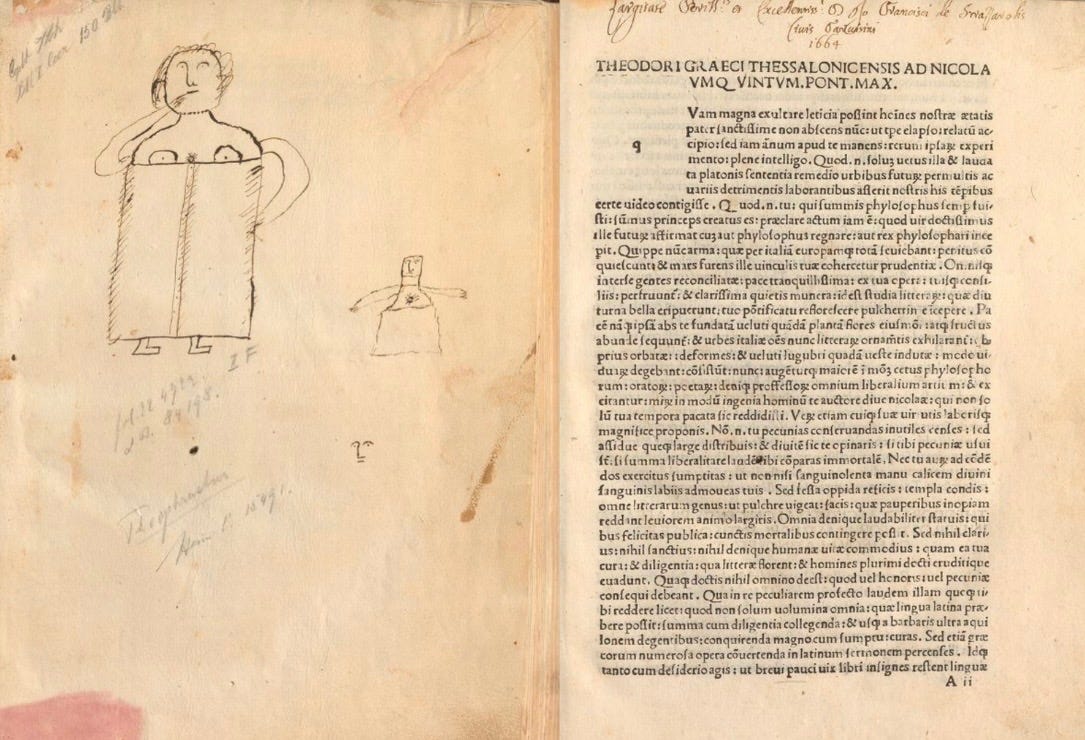
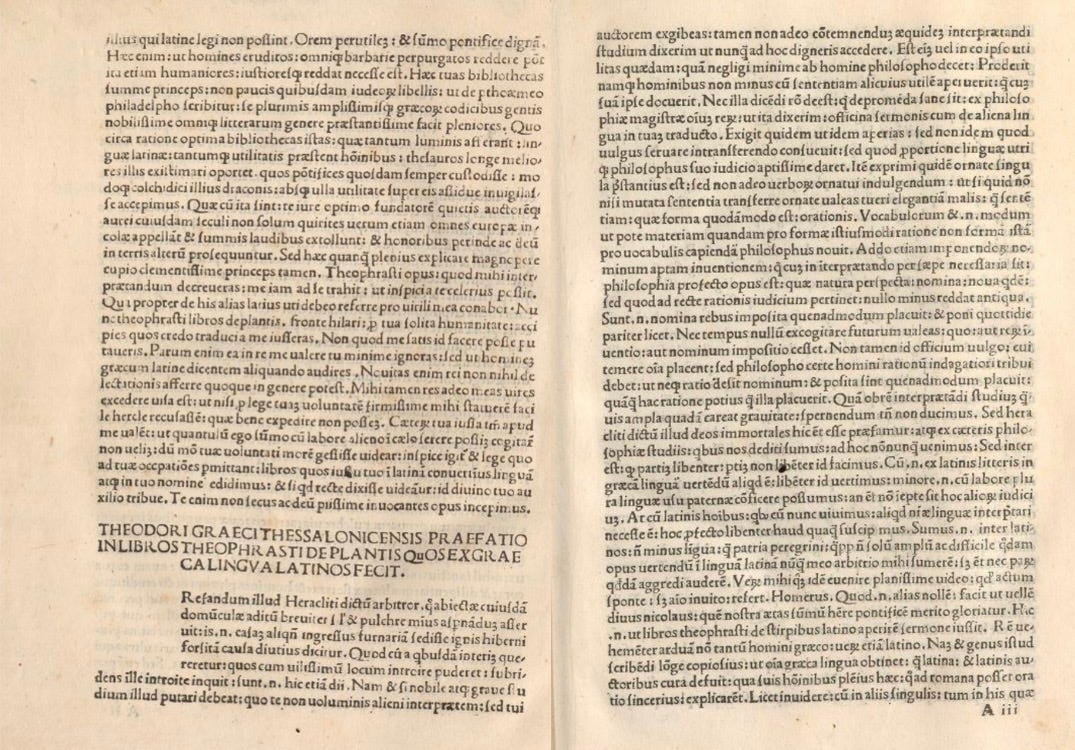
Translation:
“Theodore the Greek of Thessalonica, to Nicholas V, Supreme Pontiff
Begun in the city of Rome, by the hand of Theodore of Thessalonica, in the year of our Lord 1464.
Truly great and remarkable are the things that your wisdom, in this our age, has brought forth, things which, even if they were not already known or attested, or handed down in books, would by themselves suffice to win for you everlasting renown.
And these things, I say, are such that even those who have not experienced them may understand them, while those who have know them to be true. Indeed, the common saying that “time reveals all things” is proven true by your deeds. For all those things that were once hidden and unknown, you have brought forth into the light, and made known to all peoples and nations. You have reconciled minds divided by opinion, and restored peace and harmony where there was discord.
But why should I speak at length?
Your works themselves cry out, and speak more loudly than any voice. All things that were lying in darkness and silence, you have brought forth into the light. You have adorned the city of Rome with buildings and structures fair and beautiful, so that it may justly be called the capital of the world and the mother of all cities. You have restored what was fallen, repaired what was ruinous, and brought back to life what was all but dead, not only in the city, but also in the churches and holy places.
You have enriched the shrines of the saints with gifts and ornaments, and you have shown yourself a defender and protector of all who are in need.
Why should I speak of your generosity and kindness?
You have opened your hand to all, and your liberality has been extended even to the most remote peoples. No one who has sought your help has been turned away empty‑handed. You have relieved the poverty of the needy, supported the weak, and lifted up those who were cast down. You have bestowed honours and rewards on the virtuous and the learned, so that everyone may strive for goodness and virtue.
But above all else, your care for the Christian religion and your devotion to the orthodox faith are worthy of eternal memory. You have laboured with all your might to defend the truth against its enemies, and to spread the Gospel of Christ throughout the world. You have restored peace and unity to the Church, and you have shown yourself a true father and shepherd to the flock committed to your care.
These things are great and worthy of praise, yet there is something even greater, something that surpasses all human praise. You have sought to bring back the ancient writers and the wisdom of the ancients, which had been buried in obscurity and neglect.
You have gathered books from every corner of the world, and you have spared no expense or labour to preserve them and make them known. Where once there was scarcity, now there is abundance. Where once the treasures of knowledge were hidden away, now they are brought forth into the light for all to see.
And so, most Holy Father, these things are known to all, but what shall I say of those things that are hidden in the secret places of your heart?
Who can know the mind of man, or the thoughts of your wisdom?
Time, the discoverer of all things, will one day reveal them. For now, let this be said: you have shown yourself such a man as the ages have not seen, a man of such virtue, such wisdom, such learning, and such generosity that all who come after us will marvel at your name.
There are many who have written about your deeds, and many more will write, but few, I think, who will be able to worthily describe them.
For your deeds are greater than any tongue can tell, and your wisdom is deeper than any mind can fathom. I, therefore, though the least of all, have wished to bear witness to your goodness, and to leave behind some small memorial for those who come after, not as one who could worthily praise you, but as one who would not be silent concerning your benefits.
If there is any ability in me, any power of speech or knowledge, I have devoted it all to your service. And if I have said anything unworthy of so great a subject, let it be attributed to my weakness, not to the truth. For what am I, or what is my family, that I should speak of such things? Yet the love and gratitude I bear toward you constrain me to speak, even if I cannot speak worthily.
And so, most Holy Father, I commend myself to your Holiness. May Almighty God keep you in his care, preserve you for many years, and grant you in the life to come the reward of all your labours.
May you flourish and prosper, and may the Church of God flourish under your rule. Farewell in the Lord, and remember me in your prayers.
My prayer is earnest, and I deem it worthy of a true Pope: that men of learning, having been cleansed by the discipline of virtue, may translate these works into our tongue; for it is fitting that what has been well said should not be lost to the common good. Nor should we hide away the treasures of knowledge, keeping them known only to a few, out of envy or arrogance. For many things which have been written in Greek by men of great genius are not yet known to Latin speakers, simply because no one has translated them.
And so, if there are men of ability who might translate these works, let them come forward! There is enough to keep many hands busy: an immense harvest of learning lies waiting, ready to be gathered. Let them not be deterred by the difficulty of the task, nor by the size of the undertaking.
For what is difficult is not therefore impossible; what is hard to reach is not therefore unattainable. Let them remember that the labour is great, but the reward is greater still.
For myself, I have undertaken this labour not because I am equal to so great a task, far from it, but because I would rather offer something imperfect than remain silent and offer nothing. I have done what I could: I have translated these books, not word for word, but preserving the meaning and the sense intact.
I have not added anything of my own, nor removed anything of theirs; I have kept the very words and phrasing where possible, and where not, I have kept the thought and the argument unchanged. If I have erred anywhere, let the reader correct me; if I have done well, let him give thanks to God, from whom all good things flow.
I have been asked why I have translated these particular books rather than others. My answer is simple: because they were the ones I had to hand, and because they deal with subjects that are useful and necessary to know. First among them are the books of Theophrastus on plants, a subject both pleasant and profitable. To know the nature of things, to understand the virtues and properties of each herb and tree, what greater delight can there be? And what greater benefit to human life?
THEODORE THE GREEK OF THESSALONICA: PREFACE TO THE BOOKS OF THEOPHRASTUS ON PLANTS, WHICH HE TRANSLATED INTO LATIN.
When I had carefully examined the writings of Heraclitus, the saying of the prophet Isaiah, and the many other passages from divine and human authors which speak of the nature of plants, I was struck by a thought.
Why should knowledge of these things be kept from Latin speakers?
Why should the wisdom of the Greeks remain hidden from those who do not know their tongue?
And so, seeing that many useful and pleasant works were inaccessible to Latin readers, I undertook to translate them, not trusting in my own ability, for I know my limitations, but hoping that my labour might be of service to others.
If what I have done pleases you, good; if not, remember that I have at least made the attempt, and that it is better to have something imperfect than nothing at all. Do not despise what you have simply because it comes from a humble hand. If there is anything in it worthy, give the credit to God; if anything is lacking, blame only my weakness.
Some will say I have taken too great a liberty in translating, that I have departed too far from the Greek. Let them say what they will. I have aimed not at a literal rendering, but at clarity and sense. I have chosen words that fit our language rather than forcing Latin into Greek idioms, so that the reader may understand what he reads, rather than merely stumbling over words he cannot follow.
Let the critic understand: I have sought to be faithful to the meaning, not to the letter alone. And if anyone wishes to compare my version with the original, let him do so, I fear no honest comparison.
Where I have kept close to the text, let him give me credit; where I have departed from it, let him judge whether it was for the better or for the worse.
You may demand strict adherence to the author’s words, but that is not how translation works.
If you demand a word‑for‑word rendering, you will often destroy the meaning.
The order of words in Greek is not the same as in Latin; the idioms differ, the turns of phrase differ. To follow the original slavishly produces something that reads like a foreign tongue, not a natural one. Therefore I have kept the sense and the argument intact, but have given the language its natural flow in our speech.
Let no one accuse me of changing the author’s meaning.
I have not added anything, I have not subtracted anything. I have simply clothed the same thoughts in different words. If the thread of the argument is broken anywhere, if the meaning is obscured, let the reader point it out and I shall correct it. But if it is clear and consistent, then let the work speak for itself.
I am well aware that there are many who could have done this better than I. There are those who are masters of both tongues, who possess eloquence and learning far beyond my own. But they have kept silent. They have left the work to others, or perhaps they have waited for someone else to begin. And so, seeing the field empty and the work waiting, I stepped forward. Better an unskilled hand than none at all. Better a rough translation than no translation at all.
Do not expect the polished style of an orator here. You will find plain speech, the language of truth rather than of display. The author himself wrote simply and clearly; I have tried to keep him that way. If I have failed in that, the fault is mine; if I have succeeded, the praise belongs to him.
There is also this to consider: many things in the original simply have no exact equivalent in our tongue. We must therefore use words that come close, even if they are not perfect matches.
This is not altering the text; this is the necessity of translation itself. And so, gentle reader, take this work in the spirit in which it was made: with good will, with labour, with a desire to serve. If you find it useful, use it. If you find errors, correct them charitably. For I am but a man, and a fallible one at that.
It is the custom of the Greeks to be prolix and to delight in repetition. We Latin speakers prefer brevity. Where repetition serves a purpose I have kept it; where it is merely ornamental I have sometimes allowed myself to condense. But never to the point of losing the sense or the argument. Anyone who doubts this may compare line by line. I have nothing to hide.
And so I send this little book out into the world, such as it is. May it be useful to many. May it fall into the hands of those who will value it, who will preserve it, who will pass it on.
And may God grant that what was written in Greek for the benefit of the Greeks may now also serve the Latins, that one and the same truth may be known and loved by all nations, to the glory of God and the good of all people.”
Before there were patents, dear reader, before there were monopolies, before the study of nature was carved up into profit‑making departments, there was simply observation.
There was watching, listening, touching, and remembering.
There was the slow, careful accumulation of knowledge, passed from hand to hand, from teacher to student, from generation to generation, not locked away, not owned, not hidden behind a paywall or a brand name.
The book before us is Historia Plantarum, Enquiry into Plants, and its companion volume De Causis Plantarum, On the Causes of Plants.
Written by Theophrastus, the man who succeeded Aristotle himself as the head of the Peripatetic school in Athens, these works stand as the foundation upon which all later Western botany and herbal medicine was built.
Born around 371 BCE on the island of Lesbos, Theophrastus was not a physician in the modern sense, he was a philosopher, an observer, a man who looked at the world and asked:
What is this plant?
Where does it grow?
What does it do?
What strikes me when I turn these pages, pages that have travelled across two and a half thousand years to reach us, is how connected everything once was.
Theophrastus does not separate the plant from its habitat, its soil, its climate, its season.
He does not isolate one active ingredient and ignore the other thousand compounds that make the whole.
This was medicine rooted in relationship, not extraction.
You did not take a plant apart to find one chemical you could patent; you came to know the plant as a whole, and you knew the person you were treating as a whole too, their body, their environment, their habits, and their constitution.
There was no one pill for all people.
There was context.
There was nuance.
There was wisdom that could not be written into a single‑page prescription.
And look at what happened to this knowledge.
For centuries, it was copied, preserved, translated, debated, kept alive by people who valued it.
But then came the era we have just walked through:
the standardisation, the monopolisation, the scientific medicine that decided everything that came before was primitive, was superstition, was worthless
What was lost was not just a list of plants and their uses.
What was lost was the way of seeing.
The understanding that nature is not a warehouse of raw materials waiting to be synthesised; that a plant is more than its patentable compound; that health is not a factory to be managed, but a living thing to be tended.
Theophrastus observed the world and described what he saw, with humility, with care, with an awareness that there is always more to know.
The modern system too often observes the world and asks:
how do we turn this into a product?
That is the difference between a science that serves people, and an industry that serves itself.
And that, dear reader, is why we reach back.
Not to reject progress, but to remember what was thrown away in the name of it.
To hold the old books in our hands, to read what our ancestors knew, and to ask:
what else have they told us to forget?
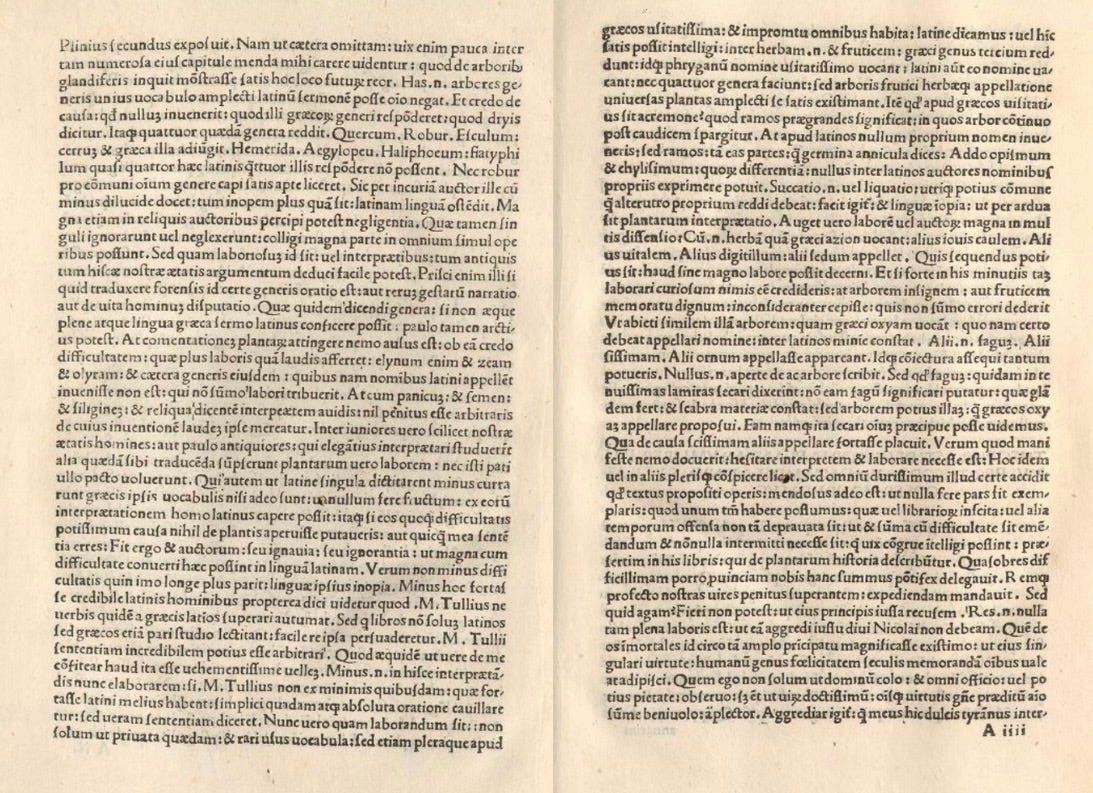
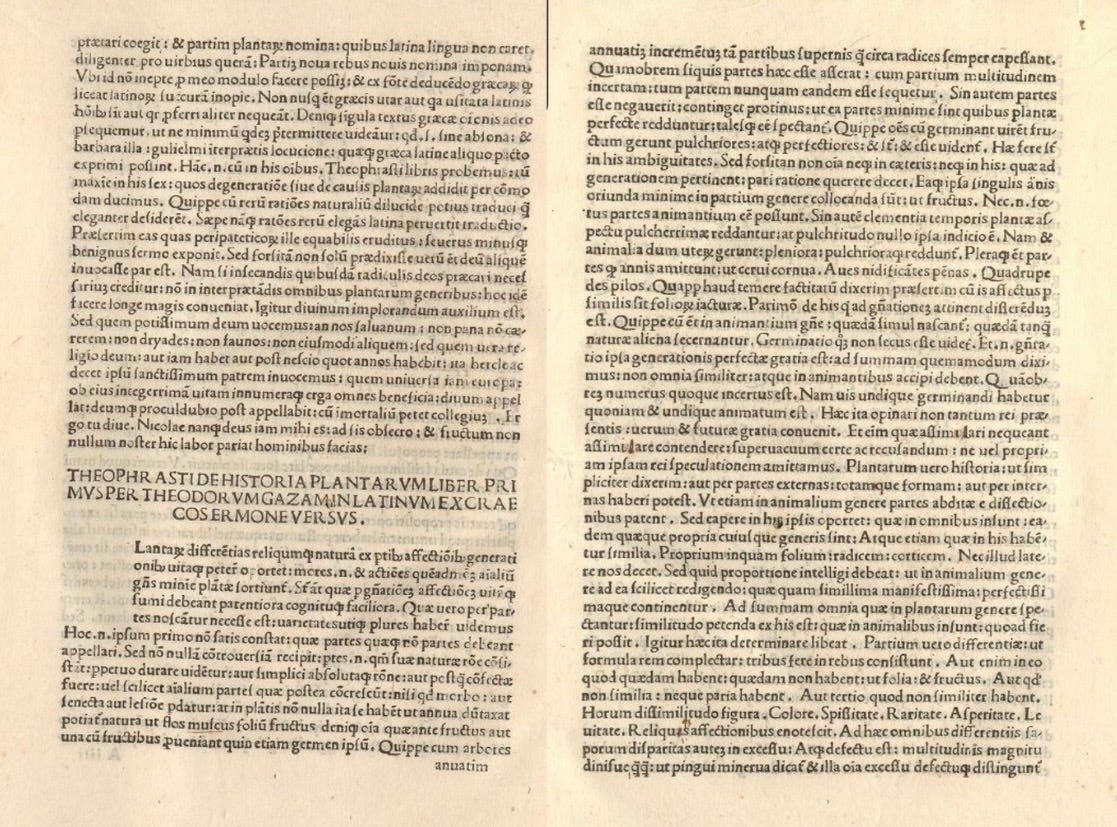
Translation:
“Pliny the Younger explains the matter. Let me set aside other points and speak of a few only: for it is no small task to give a single appropriate name to each tree and plant.
The Greeks have given names to different kinds of trees, ash, beech, and others, and one cannot find in Latin an equivalent name for every single one. I am speaking here of trees specifically: the oak, the beech, the ash, the maple, the poplar, the willow, the elm, the chestnut, the walnut, the pine, the fir, the cypress, and the rest.
Among these, the Greeks have names for some that match ours, but for others they do not. No one, for example, will find a single Latin word that matches the Greek name for the prinos, for it has no exact equivalent in our tongue. So it is with many others.
This is the first difficulty: names do not always translate. But there is a second, greater one. The Greeks have many names that are common property, used everywhere, while ours are often local, found only in certain regions. So you may know a plant by one name in your part of the country, and by something entirely different a few miles away. This makes the study of plants especially difficult.
There is yet another problem: some authors describe plants in one way, some in another.
The same plant is called different names by different writers. And so it happens that what one author praises under one name, another criticises under a different one, and the reader is left confused, not knowing if they are reading about the same thing at all.
This is why careful observation is so necessary. It is not enough to read what others have written; one must also see with one’s own eyes. Many things cannot be described in words alone, they must be seen to be understood.
The shape of a leaf, the colour of a flower, the way the branches grow, these things are easier to recognise than to explain. And so the student of nature must go out into the fields, into the mountains, into the woods. He must see the plants growing in their own place, in their own soil, in their own season.
He must compare what he sees with what he reads, and so build up his knowledge, not from books alone, but from books and nature together.
Some things are common everywhere: the names of the fruits we eat, for example, are known to all. But when we turn to less familiar plants, to those used in medicine, to wild herbs, there the confusion begins.
The Greeks have names that are widely agreed upon; we Latins have no such agreement. And so, when we translate from Greek, we must guess, sometimes correctly, sometimes not, which plant is meant.
There is also the question of authority. Which writer do we trust? The ancient Greeks? Or those who came later? Different authors disagree. And in this disagreement lies the opportunity for error. One man describes a plant from hearsay, not from seeing it; another copies from him; and so a mistake is passed down through generations.
I have tried to avoid this.
Where I have found agreement among writers, I have followed it. Where they disagree, I have said so. Where I could not be certain, I have said that too. For it is better to admit ignorance than to teach falsehood. I have also added the names by which each plant is known in different regions, so that the reader may recognise it by whatever name he calls it.
And let no one expect from me the polished language of an orator. I write of nature, and I write plainly. My subject does not demand eloquence; it demands truth. If I have succeeded in making things clear, that is enough. If anywhere I have been obscure or brief beyond necessity, let the reader bear in mind how many things must be said, and how briefly, and how much remains unsaid even so.
I have not followed any one author alone. I have read them all, and where they agree I have followed; where they differ, I have chosen what seemed most likely. But in all things, I have preferred to keep close to the Greek originals, so that if anyone wishes to compare, he may do so. I have also noted the names used by our own people, so that the book may be useful not only to scholars but to farmers, to travellers, to anyone who lives close to the earth.
This is a great and difficult subject. It grows larger the more one studies it. There is something new to find in every season, something that was missed before. And so I say: let the reader not believe everything he reads. Let him look for himself. Let him test. Let him see. For the greatest authority on nature is nature itself.
Many things have been omitted, many touched upon only briefly. That is the nature of things: the subject is infinite, but the page is finite. And so I have touched upon many things, and explained a few fully, but much remains that must be sought elsewhere, or discovered by one’s own labour.
I have also added the causes of things, why plants grow where they do, why some are annual and some perennial, why some die if moved and others take root anywhere. These questions are deep, and the answers are not always certain. I have set down what I have found, but I do not claim to have found everything. Let the diligent reader go further. Let him question, observe, record. And let him remember: the study of nature is a journey without end.
The Greeks have names that are everywhere the same. We Latins have names that change from place to place. What one region calls one thing, another calls something else.
This is a great obstacle to knowledge. The Greeks, too, have their own difficulties: some names are common to all, others are peculiar to certain peoples. But even so, they have far more agreement than we do.
There are also plants that the Greeks have simply named generally, giving one name to a whole group, while we would distinguish many kinds within it. And so when we translate, we must guess: which one exactly is meant?
Sometimes it is clear; often it is not.
There is also the problem of new names. Some writers invent names where none existed before, or coin new ones from old words, and then everyone begins to use them. Others again reject names that have been used for centuries and introduce something new, and so confusion grows rather than lessens.
Some authors describe plants so briefly that you cannot tell what they mean. Others describe them so elaborately that you are none the wiser. Some give only the name; others give a description but it applies equally well to three or four different plants. Some add the habitat and the time of flowering, that helps.
Some add the medicinal use, that helps too. But many give nothing but the name. And so the reader is left guessing.
There are those who translate word for word from the Greek, and produce something that sounds foreign in Latin. Others translate the sense, not the word, which is better, but then you lose the exact phrasing. And so the translator walks a narrow path: too close to the original and you sound strange; too free and you may change the meaning.
I have tried to steer a middle course. I have kept close enough to be faithful, but free enough to be clear. Where a Latin name existed and was widely accepted, I have used it. Where there was none, I have either kept the Greek name or made one up that seemed suitable, but I have noted which is which.
Let no one be quick to criticise. If you know a plant by another name, remember that it may be so called in your region but not elsewhere. Do not assume that because you call it one thing, everyone does. And do not blame the author for confusion that comes from the variety of human speech.
I have also noted the different names used by different peoples and in different regions, so that wherever you are, you may know what plant is being spoken of.
This was no small labour, but necessary. For what use is a book on plants if you do not know which plant is meant?
There is also this: many plants have virtues that are not yet discovered. The Greeks knew many things that have since been forgotten. And there are many things still waiting to be found. So let the reader not think that everything has been said. Much has been observed; much remains to be observed.
I have also included the opinions of different authors, where they agree and where they disagree. I have not hidden disagreements away, because truth is often found in the debate. And where there is uncertainty, I have said so, because it is better to confess that we do not know than to pretend knowledge we do not have.
And so this work is offered to you, not as the final word, but as a foundation. Build upon it. Correct what is wrong. Add what is missing. For no one person can know everything. And the knowledge of nature is the work of generations.
Do not expect perfection. There are faults here, no doubt, some from the original authors, some from me. But the intent is good. And the labour is real. If you find it useful, use it. If you find errors, correct them gently. And remember: it is easier to criticise than to create. It is easy to sit in judgment on a book; it is hard to write one.
And so I send this volume out into the world. May it fall into the hands of those who will value it, use it, and improve it. And may the study of nature continue to flourish, not for profit, not for fame, but for the good of all people and partly the names of plants, for which the Latin tongue is not well provided, so that we may inquire into them carefully.
Where names are lacking or unclear, we have supplied them as best we could. Where the Greek term could not be carried over exactly into Latin, we have followed common usage. Where usage too was uncertain, we have had recourse to a description. This is difficult enough in itself: to translate words from one language into another without losing their meaning, especially when dealing with technical terms that have no exact equivalent elsewhere.
This is why Theophrastus himself, writing in Greek, found it no easy task. How much harder then is it for us, writing in Latin, to match the precision of the original! And so if anything appears somewhat rough or unpolished, let the reader remember that we are treading a path where no Latin writer has gone before. We have had to coin words where none existed, to adapt phrases, to make the language serve a subject it was never shaped to carry.
We have also avoided overly poetic or ornate language. We have aimed for clarity above all, for this is a subject where obscurity destroys knowledge. We have kept close to the way things are commonly named and spoken of. Where custom has established a term, we have used it, even if it is not perfectly logical. Where there was no custom to follow, we have chosen what seemed most fitting.
We have also had to deal with the fact that many plants are known by different names in different regions. What one people calls one thing, another calls something else. We have noted these variations where they seemed necessary, but to list every local name would make the work too long and cumbersome.
Some things we have left in the Greek tongue simply because there is no Latin equivalent that carries the same meaning. The nature of the plant itself, its appearance, its qualities, these are often easier to show than to name. And so where words fail, we must rely on observation.
THEOPHRASTUS: ENQUIRY INTO PLANTS, BOOK THE FIRST, TRANSLATED FROM THE GREEK INTO LATIN BY THEODORE OF THESSALONICA.
There are many ways in which plants differ from one another. We may look at their manner of generation, how they come into being. Some spring from seed; others grow spontaneously from the earth, as if brought forth by chance. Of those that come from seed, some resemble their parents exactly; others produce something different. And there are those that arise from roots, from shoots, from cuttings, from graftings, each method producing its own kind.
This in itself is a great field of inquiry. We see that some plants come into being in one way and some in another. Some never appear unless sown; others spring up of their own accord. Some can be multiplied by every method, by seed, by root, by cutting, by grafting, while others refuse all but one.
Some may be moved and transplanted; others die if you so much as touch them. Some grow from a bulb, some from a rhizome, some from a fleshy root, some from woody stock, and each of these ways tells us something about the nature of the plant.
Again, some are annuals, completing their whole life cycle in a single season. Some are perennials, living on year after year. Some are herbs that die down in winter but spring up again; some are shrubs; some are trees. And within these categories there is endless variety.
Some trees are tall and straight; others spread wide. Some are evergreen; some shed their leaves. Some love the mountains; some the plains. Some grow best in wet ground; some in dry. Some in shade; some in full sun.
And then there is the question of fruit, or the absence of it.
Some plants bear fruit abundantly; some sparingly; some not at all, though they may flower. Some flower and fruit in their first year; others take many years. Some bear once and die; others bear year after year, almost without end.
All these things, the manner of growth, the shape, the size, the bark, the leaf, the flower, the fruit, the root, the season, the habitat, are the signs by which we know a plant. And no single one of these signs is enough on its own. You must take them all together if you would know what stands before you.
There is also the question of usefulness. Some plants are food for humans, some for animals, some for medicine, some for crafts. Some are harmful, some helpful, some neutral. And even here there is no simple rule: what nourishes one may poison another. The same plant changes with soil, with climate, with age. A herb gathered in one season may have little virtue; gathered in another, it may be powerful.
And so the study of plants is not a thing that can be learned from books alone. You must go out. You must see them growing. You must touch, smell, taste, cautiously, and watch through the seasons. You must compare what you find with what is written, and what is written with what you find. For the book is the map, but the earth is the territory and with each year's increase, certain parts, especially those around the roots, become permanent and established.
Now we must speak of the parts of which plants consist. Some are common to all, some peculiar to certain kinds. Some are visible to the eye; some hidden. Some are essential; some appear only later, as the plant matures.
The principal parts are these: root, stem, branch, leaf, flower, fruit, seed. But not all plants have all of these. Some have no fruit; some no flower; some no distinct stem. Some have parts that look like one thing but are really another. And so the student must be careful not to be misled by appearances alone.
The root is the foundation, the anchor and the mouth. It draws nourishment from the earth and holds the plant fast. Roots differ greatly: some are single and deep; some many and spreading; some thick; some thin; some fleshy; some woody. Some live for a year; some for centuries.
Then there is the stem or trunk, the body of the plant. Here too there is great variety: soft and herbaceous, or hard and woody. Tall or short. Single or many-branched. Smooth or rough, barked or bare.
From the trunk come the branches, and from the branches the twigs. These too differ greatly in number, length, thickness, shape, and direction. Some spread wide; some reach upward; some hang down. Some are thick with leaves; some almost bare.
Then the leaves, the clothing of the plant. In shape, size, colour, arrangement, there is endless diversity. Simple or compound. Opposite one another, or alternating. Jagged edge or smooth. Stalked or sitting directly on the branch. And the way they fall, or stay, tells us much too.
Then the flower, for those that flower. Some are large and showy; some small and hidden. Some grow singly; some in clusters. They differ in colour, scent, time of appearance, and duration. And within the flower lie the beginnings of the fruit and seed.
Then the fruit, or vessel containing the seed. Here again: shape, size, colour, flavour, number of seeds, time of ripening, all vary. Some are fleshy; some dry. Some open when ripe; some remain closed. Some are good to eat; some bitter, some poisonous.
And finally the seed, the potential for a new life. Some seeds are large; some like dust. Some carried by wind; some by birds; some clinging to fur. Some remain viable for years; some must be sown at once.
These are the principal parts. But nature does not always keep neatly to our categories. There are things that look like leaves but are not; things that look like fruit but are something else entirely. There are thorns, prickles, hairs, glands, resins, gums, milky juices, all things that serve the plant in ways we do not yet fully understand.
And so we must observe not only the parts but also the whole. How the plant stands. How it branches. How it clothes itself. How it changes through the year. How it responds to sun and shade, wet and dry.
Some things are common to all living things: birth, growth, maturity, decline, death. But plants differ from animals in this, they do not move from place to place.
They are rooted where they stand. And so they must endure what comes, the heat, the cold, the wind, the rain, or perish.
Their defence is not flight but form: thick bark, bitter leaves, sharp thorns, or simply growing where enemies cannot reach them.
Some plants are solitary; others grow together in communities. Some are short-lived; some outlast empires. Some seem almost immortal, sending up new shoots when the old trunk falls. And so the boundary between individual and colony is not always clear.
There is also this: plants of the same kind differ according to where they grow. The same tree will be taller and straighter in a dense forest, shorter and broader in the open. The same herb will be larger and greener in rich soil, smaller and tougher in poor. Sunlight changes them. Rainfall changes them. Altitude changes them. And so you cannot know a plant from one place alone, you must see it in many places, in many seasons.
We must also consider the nature of the plant's body: whether it is woody or herbaceous, solid or hollow, pithy or fibrous, juicy or dry. Whether it yields a sap, a resin, a gum, a dye. Whether it is smooth or hairy, stinging or soft. All these things are clues to its nature and its powers.
And so we come back to where we began: the study of plants is the study of the visible world. It is not hidden behind symbols or formulas. It stands before you. But you must look. You must see. And seeing, you must remember. For nature speaks plainly, but only to those who listen.”
And so, dear reader, we have cast our gaze over some modern truths and some ancient wisdom, let us reflect.
Health was once something people lived, not something they bought.
Every village once held knowledge of the land, which plants cooled a fever, which soothed a cough, which mended a cut.
That wisdom was not written in a single book.
It was stitched into daily life, passed across kitchen tables and garden fences, carried in the hands of grandmothers and healers.
Then came a different kind of power.
Men with fortunes and influence redefined what healing meant.
They framed the body as a machine to be managed, maintained, and kept productive.
They built universities and journals and government bodies until their version of truth became the only one allowed.
Anything else was dismissed as folklore or fraud.
While this new system took shape, the very people attacking old knowledge sent collectors across the world.
They scoured forests and mountains, interviewed elders, and gathered plant samples.
Back in labs, they isolated compounds, modified them slightly, and claimed exclusive ownership.
Remedies that had been free to humanity for thousands of years suddenly came with a patent and a price tag.
This is the pattern that repeats across history.
Something shared by everyone is taken, privatised, and sold back.
The ancient books tell a story that no longer fits modern textbooks.
Writers like Theophrastus and Pliny did not look at nature and see raw materials waiting to be processed.
They saw living things deeply tied to their surroundings, soil, sun, season, and altitude.
They understood that the same herb could act differently depending on where it grew and who prepared it.
They treated the whole person, habits, home, climate, and constitution, not just a single symptom.
That way of seeing has been systematically dismantled.
People today are taught to look for one answer, one expert, one pill.
Trust in personal experience has been eroded.
If a label contradicts what the body feels, the label is believed.
If a textbook conflicts with what the eyes see, the textbook wins.
That erosion of confidence is not accidental; uncertainty creates reliance, and reliance creates customers.
There is no fundamental reason why anyone should not know the plants growing within walking distance of their own door.
That knowledge was once universal.
Now it is guarded behind degrees and licensing systems.
That shift did not happen because herbal medicine was proven ineffective, it happened because self-sufficiency threatens profit.
An industry built on treatment cannot thrive on prevention.
People who stay well and tend to their own needs do not generate recurring revenue.
The business model relies on constant, manageable illness, conditions that require lifelong prescriptions rather than a return to balance.
Textbooks can be rewritten.
Definitions can be changed.
History can be reshaped.
But nature does not care about papers or titles.
A plant will grow and heal regardless of who claims credit.
The real power does not sit in boardrooms, it sits in the soil, the seed, and the turning of the seasons.
It sits with anyone willing to watch, learn, and remember.
That knowledge was never truly lost, curious mind, it was just hidden.
Buried under red tape, confusion, and rewritten history, but the books survived, the seeds survived, and the earth still speaks plainly to anyone who stops to listen.
If you choose to support this work, know that your presence and engagement are valued far more than any material gift.
Your focus here, on these forgotten lines of thought, is the true contribution.
Should you still feel compelled to assist, understand that any resources provided go entirely toward the procurement of rare historical texts, ensuring they are rescued from obscurity and kept safe for those who come after us.
Thank you, dear reader.
And now, They're just pumping and dumping TONS of Their garbage on our heads and agriculture and nature. F'ing up our health, the health of our world, the weather...
We need to END THEM SOON, or there ain't gonna be much left.
Which is maybe how it's supposed to go anyway.
"Medicine" is about profit. "Health" is the marketing mantra. No one studies healthicine.