
Creation Before Darwin
What Did the World Believe Before the Evolution Story?

Did you know that the origin story taught across the entire Western world rests upon the foundation of a single book, dear reader?
One publication became the bedrock of all modern thought, reshaping how every soul understands from whence it came.
That book bears the title:
On the Origin of Species
It was presented to the public in 1858 as the work of Charles Darwin and Alfred Wallace.
Yet when we pause to place it in time, we see it is astonishingly recent; a whisper in the vast chronicle of human understanding, and far removed from the ancient wisdom we explore together.
The ideas contained within those pages were not conceived by the two men to whom they are attributed.
They were not born of observation aboard a ship, nor of independent discovery.
These teachings trace their lineage directly to the mind of one man, Charles Darwin’s grandfather:
Erasmus Darwin
Erasmus was a Master Mason, initiated into the society in 1754; he laid every stone of this theory long before his grandson was even born.
He set forth his vision in works bearing titles you may never have seen:
The Temple of Nature
The Botanic Garden
These are not books of science, curious mind, they are written in verse, deliberately veiled in the language of symbolism, and enriched with Masonic imagery and Rosicrucian doctrine.
They speak openly of a world rising from slime, ascending by gradual stages toward some imagined perfection.
It is a doctrine of endless material progression, and it aligns perfectly with the work of the society; yet it stands in utter contradiction to the account held sacred by humanity for thousands of years.
Erasmus gathered with others of like mind within what became known as the Lunar Society; a circle of industrialists, inventors, and philosophers whom met only beneath a full moon.
Josiah Wedgwood, James Watt, Matthew Boulton, Joseph Priestley; names you may recognise as architects of the modern age.
These men did not just discuss steam and pottery, they were bound by marriage, by finance, by secret fraternity, and by a shared vision:
to reshape the human mind by rewriting its beginning
Remember that name, dear reader, the Lunar Society, for it will appear again soon.
Of Erasmus’s fourteen children, two followed him into the craft, both becoming Master Masons.
Sir Francis Sacheverel Darwin attained that rank, and Reginald Darwin likewise.
Charles Darwin’s father, Robert, was never initiated into the society, yet he had no need to wear the apron.
He married Susannah Wedgwood, daughter of Josiah, the founder of the Lunar Society, and through that union, the families, the fortunes, and the purpose became one.
Robert Darwin built the wealth that funded Charles’s voyage, and his entire life of leisure.
He stood within the circle even if he did not carry the title.
We are not speaking of separate societies or competing interests, dear reader, we are beholding one vast, interconnected network; woven by blood, by marriage, by secrecy, and by gold, all labouring toward a single, deliberate end.
And so we must speak plainly:
the theory of evolution was conceived first by a high-ranking Mason, passed down through family and fortune, and placed before the world in 1858 as though it had sprung fresh from observation
It was not discovery, it was doctrine, and once released it swept across the globe with incredible speed, dismantling the ancient understanding that humanity was created, deliberately and directly, by a living God.
In its place arose a new faith, that all things are an accident, that we arose from the mud by chance, and that there is no purpose but what we forge for ourselves.
This is the heart of Scientism, the deliberate replacement of the Creator.
Now that we have pulled back the curtain and seen where the modern tale truly began, let us turn our eyes backward.
Let us leave behind the doctrines of the last two centuries and behold what humanity believed for thousands of years; before they told us we came from nothing.
We turn back to Pimander, curious mind, the voice of Hermes Trismegistus, whom some call Thoth, whose words arose from the banks of the Nile at the earliest point in recorded history.
These teachings are older than the Greeks, older than nearly every voice still heard upon the earth.
They speak of light, mind and the divine Word, of humanity created in the image of God, and of the knowledge that can reunite us with our source.
These were not whispered in secret.
They were revered, studied, and preserved across millennia, until the day arrived when it became necessary to bury them beneath a new story.
Let us cast aside all that we have been taught, and sit for a while beside these ancient pages.
Perhaps by the end of our time together this evening, you shall understand not only what was once believed, but also why it was replaced; and in knowing that, you may find yourself understanding a little more about who you truly are.
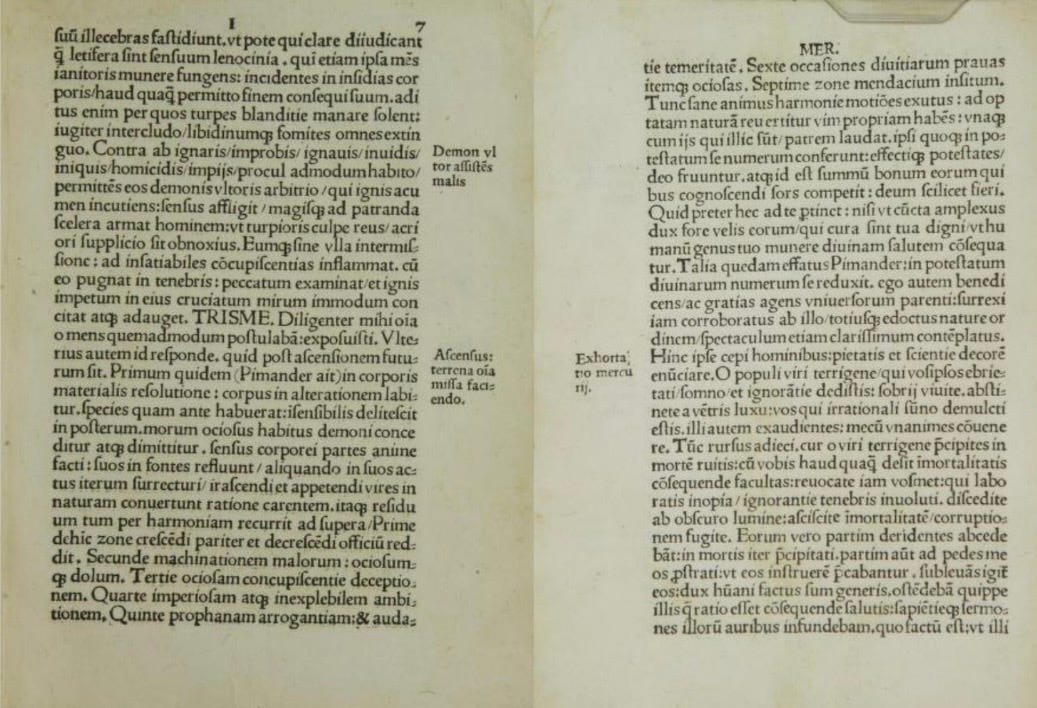
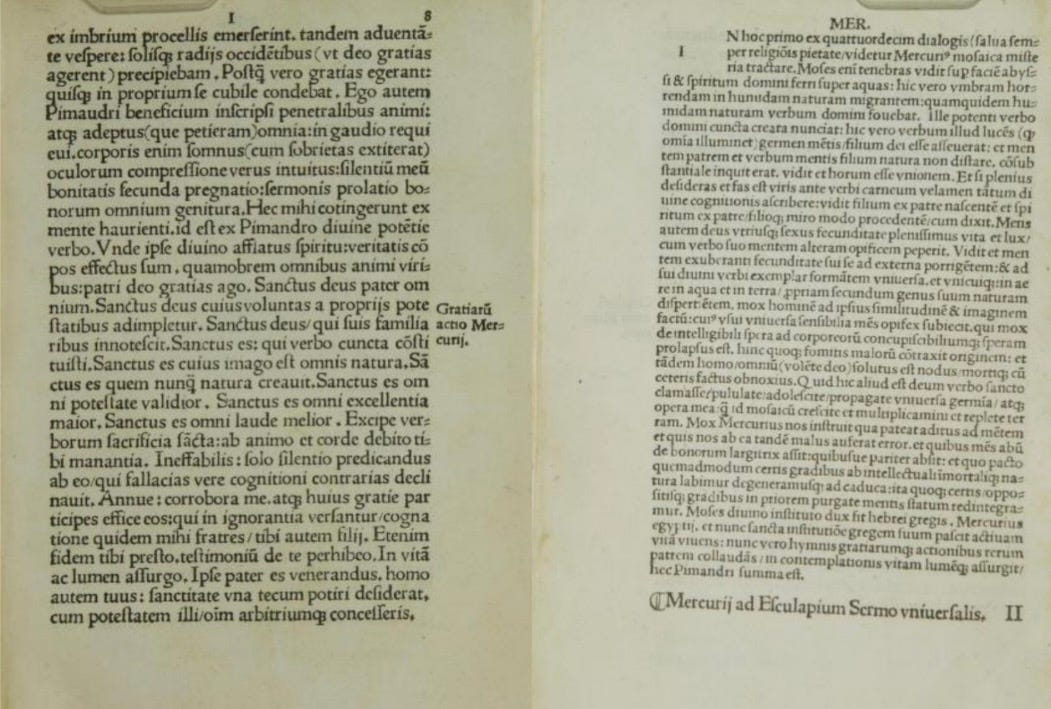
Translation:
“For even the very senses are lulled to sleep by allurements, and the soul, led unawares, is drawn into hidden snares and suffers wounds no one may see.
Pleasure flows forth with soft enticement, ever returning, and ever shutting out pain. Lust and desire become the nourishment of all wickedness. Against such men, wicked and lawless, the fire of wrath burns. Those who are cruel, unjust, murderous, impious, and far removed from all goodness, shall be given over to the dominion of evil spirits. They shall be afflicted by them, and urged on to every crime and every transgression. Their conscience shall be their accuser, and their punishment shall be unceasing.
And then shall anger be kindled, and rage inflame the mind. The cause of sin shall be examined in the shadows, and the impulse of the wicked shall be restrained and broken.
These things, then, are the five degrees of the soul. First, the soul is overcome by the allurements of matter, and turns aside from the right path. Second, it is entangled in wicked schemes and deceits. Third, it burns with the unbridled fire of desire. Fourth, it grows arrogant and insolent beyond measure. Fifth, it becomes bold and defiant in all things.
Rashness and folly bring many evils upon men. Wherefore one must choose the better part. When the soul is in harmony and order, it brings forth good fruit, and bears witness to the excellence of its works. But when it is divided against itself, it loses its power and virtue. All things that are brought forth are good, and all things that are good are worthy of praise. That which is most excellent is known and understood by few. How blessed is the man who has attained to wisdom!
How noble is the soul that has laid hold of virtue! He who cleaves to God shall be exalted, and shall be made ruler over all things. He shall receive the reward of immortality, and shall shine forth in glory. He who walks in darkness knows not the light, and his portion is sorrow and weeping. But he who has understanding shall rejoice, and his joy shall be full. He who has ears to hear, let him hear.
At length, after storms and tempests, the light breaks forth, and the sun rises clear and bright, as though it were evening and dawn in one. And when the hour of rest was come, they gave thanks in silence. And I, Pimander, poured forth the prayer of my heart, and besought Him to grant me understanding. And straightway there fell upon me a sweet and solemn calm, and my eyes were opened, and I beheld the goodness and beauty of all things. And my soul was filled with wonder, and I drank in the wisdom of God. And thus, being filled with the divine power and word, I understood all things that are, and all things that shall be. And I gave thanks unto Him who has made all things, and who upholds all things by the word of His power.
Holy art Thou, O God, who hast made all things. Holy art Thou, whose will is fulfilled by Thy ministers. Holy art Thou, who hast established all things. Holy art Thou, O Nature, whom Thou hast created. Holy art Thou, O Wisdom, who hast poured forth Thy light upon all generations. Holy art Thou, O God, whose word is beyond all praise. Holy art Thou, to whom all things owe their being. Thou art He who is, and who was, and who shall be. Thou art the beginning and the end, the one and the same, the Author and the Upholder of all things.
This is the first discourse, in which the false opinions of the world are laid bare, and the true worship of God is set forth. And now, let us consider the second discourse, which is of yet greater weight and wisdom.
For as the rain and the snow come down from heaven, and return not thither but water the earth, making it bring forth and bud, giving seed to the sower and bread to the eater, so shall My word be that goes forth from My mouth. It shall not return to Me empty, but it shall accomplish that which I purpose, and shall prosper in the thing for which I sent it.
And there appeared to me a great light, and in the light a divine form, and from the form came forth a voice more clear than light itself. And the voice said: Behold, I am the Word, the Son of God, the Wisdom before all worlds. I am He who is in the Father, and the Father in Me. I am the Light of the world, and the Truth, and the Life. No man comes unto the Father but by Me. I am the Way, and the Door, and the Shepherd. I am the Resurrection, and the Life. He that believeth in Me, though he were dead, yet shall he live. And whosoever liveth and believeth in Me shall never die.
These things I have spoken unto you, that in Me ye might have peace. In the world ye shall have tribulation, but be of good cheer. I have overcome the world.
Mercury to Asclepius: A Discourse Concerning the Whole”
And so, dear reader, we turn now to the words themselves, not the thoughts of some later scholar, nor the opinions of those who came after, but the voice of Hermes himself.
These are the teachings handed down at the dawn of wisdom; preserved with reverence until this edition was set before the world in 1505.
The printer gave them paper and ink, but the words belong to an ancient teacher, and through them he speaks to us still, as clearly now as he did then.
Read closely as to what he tells us of the soul and its descent, curious mind.
He marks five stages by which light becomes dimmed, and truth grows distant:
Allurement of Pleasure, the deceiver that lulls the senses and draws the heart away
Deceit, when we begin to fashion truth to suit ourselves
The Fire of Unbridled Desire, consuming all judgment
Pride, when the self is exalted above all things
Hard Defiance, when reverence is cast aside entirely
These are not theories, nor guesses; they are the map of every soul that turns away.
He spoke these words thousands of years ago, and they remain as true today as the tides.
And then he tells us, dear reader, that the fall is not final; there comes a moment of remembrance, a turning back toward harmony, a gathering of strength to ascend once more.
He teaches that we are not cast here by chance, nor shaped by blind necessity; we are beings on a journey, capable of falling very low, yet carrying within us the power to rise again.
There is order, there is purpose, and there is a way out of the shadows; if only we remember who we are.
As we continue, his voice rises in praise; we hear what humanity once believed of God.
Holy art Thou, he says, Holy art Thou, seven times holy unto Him who is and was and is to come
He speaks of a living Mind, a divine Word, a Wisdom that stretches through all of creation; the Creator he speaks of is not distant, nor indifferent, but present in every light and every breath.
Then he speaks of us, curious mind, made in that image, bearing that likeness, carrying within ourselves the very nature of the One who made us.
This is what Hermes taught, and this is what the world believed for thousands of years.
Do you see the stark differences between this and the tale we are given today, dear reader?
We are taught that all things exist by accident
Hermes teaches that everything had a purpose
We are taught that we rose from the dust by chance, for no reason and without destiny
Hermes teaches that God made us in his image from light, and our real home is with Him
We are taught that matter is all, and the soul but a shadow
Hermes teaches that matter is but a garment, and the soul is the substance
Do you feel the weight of that difference, dear reader?
These words were spoken long before any modern tale was ever conceived; they were revered, studied, and preserved across millennia, until the day arrived when it became necessary to set them aside, and tell the world a different story.
But Hermes still speaks, his words were not silenced.
They rest here, unchanged, unbowed, waiting for those who have eyes to see.
He tells us we are not accidents.
He tells us we carry within us the image of the Creator.
And he tells us that the greatest discovery any soul can ever make is simply remembering who you are.
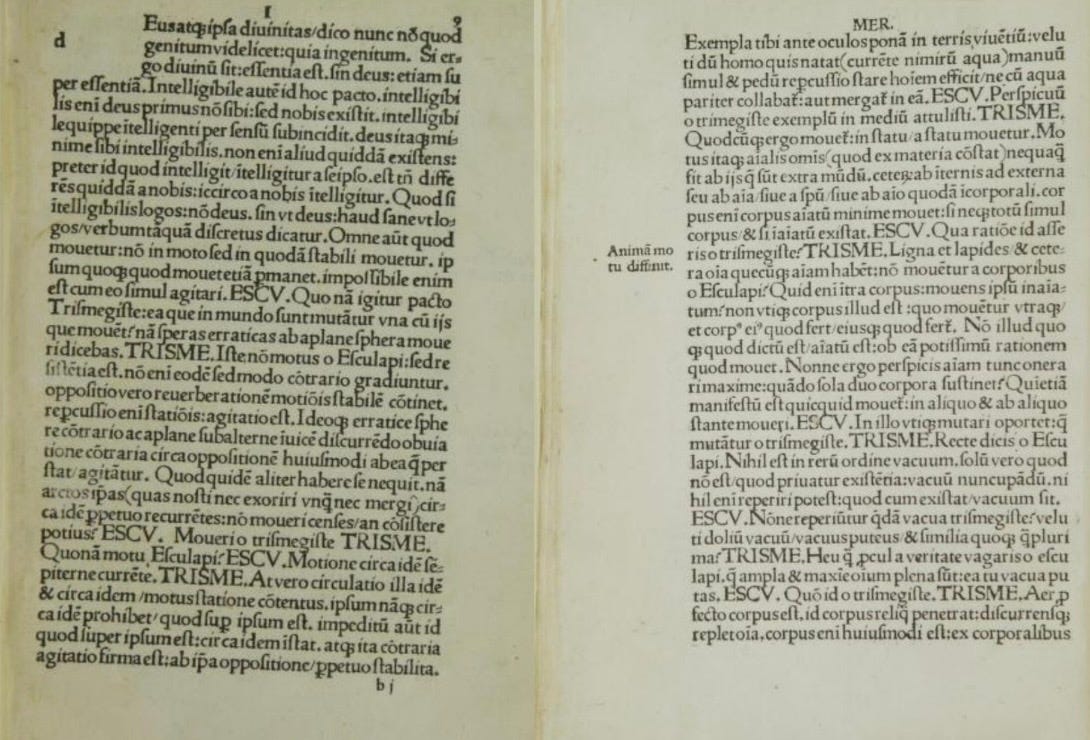
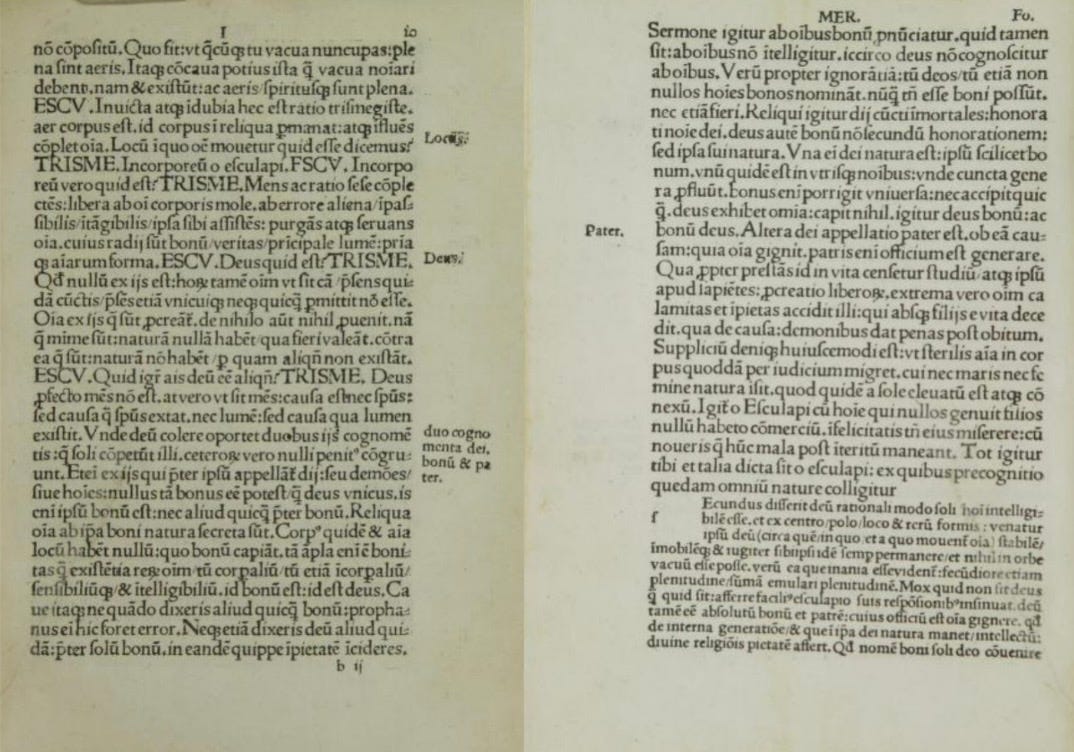
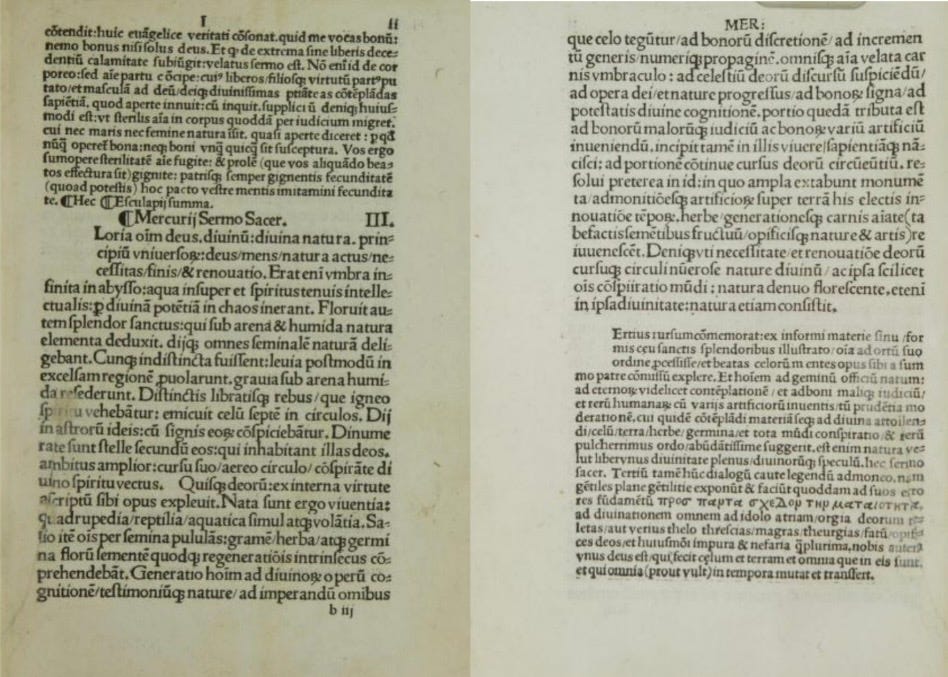
Translation:
“I shall speak now of the divine nature, that which is truly unbegotten. Understand this well. If God indeed exists, then He is all things, and from Him all things proceed. He is not brought forth by any cause, nor subject to any condition. He may be known only by the understanding, and not by the senses of the body. He is prior to all things, and before all that may be named. He may be grasped by the mind alone, and even then only in part. He is beyond all that may be spoken or conceived. He is that which is, and that which is not, yet in such a way that nothing may be likened unto Him. He knows Himself, and is known to Himself alone. There is nothing before Him, nothing beside Him, nothing greater than He. He is both the understanding and that which is understood. There is no God beside Him. All things are upheld by His word, and by His will all things are moved. That which is moved is moved by Him, and that which abides does so by His steadfastness. He fills all things, yet is contained by none. He passes through all things, yet remains unshaken. He is everywhere and nowhere at once.
Consider then how this may be. Behold all things in this world are in motion. Some move in one fashion, some in another, as though borne upon a sphere. Yet they do not move at random, nor without order. If you cast a stone upward, it returns to the earth. If you heat water, it rises as vapour and descends again. All things move according to their nature, and where there is motion there is also restraint, and where there is strife there is harmony. Opposites uphold one another. That which resists gives stability to that which stands. Motion is met by rest, and rest by motion. All things are drawn together and held apart, forming one great and endless balance.
Consider the elements. Fire rises, water descends, air moves between them, earth stands firm. None may change their own nature, yet each may be transformed into another. Fire becomes air, air becomes water, water becomes earth, and earth in turn may give rise to fire again.
This is the eternal turning, the great wheel that never rests. Yet beneath all motion there stands one unmoving Cause. That which sets all things in motion must itself be unmoved. That which orders all things must itself be beyond all order. That which binds all things must itself be bound by nothing. It stands firm, and from its stillness all motion comes. It forbids excess, yet it is itself without measure. It hinders disorder, yet it is itself unhindered. It gives stability through opposition, and permanence through that which appears to change.
Behold a likeness set before your eyes upon the earth. Consider the living body. It moves, it breathes, it acts. Yet it stands firm upon the ground, and does not drift away. It is held together by something that is not itself. Within it there is warmth, there is breath, there is life. And yet these things are not the body, they dwell within it and sustain it. Even so does the Divine Presence dwell within the world. It moves all things, yet is not itself moved. It upholds all things, yet is not itself upheld. It is in all things, yet is not any one thing. It is everywhere and nowhere at once.
Consider also wood and stone. They do not move of themselves. Yet set them in their place, and they stand firm. They are held in being by the same order that holds the stars in their courses. That which gives being to all things is itself beyond being. That which gives form to all things is itself without form. That which moves all things is itself unmoved. There is no true void, no empty space anywhere. What seems empty is in truth filled with that which the eyes cannot see.
Nothing exists that is not filled with God. He dwells within all things, yet is distinct from them. He is all things, yet He is no one thing. He fills every vessel, yet is not contained by any. He is the life within the seed, the light within the flame, the order within the turning worlds. He is all in all, and beyond all.
And so it is with all things. That which seems empty is not empty, but filled with that which the eyes cannot see. We speak of air, and space, and void, yet even the void is filled with the presence of God. There is nowhere He is not, nowhere that He does not sustain and uphold all things. He is within all things, yet distinct from them. He is all things, yet He is no one thing. He is mind, He is life, He is being itself.
Consider then what truly is. All things that you see are formed and pass away. Yet that which forms them remains forever. The body changes, the face alters, the years come and go. Yet within there abides something that does not change, something that knows, something that sees.
That is the true self, that is the likeness of God within you. All outward things are but garments, and they wear out and fall away. But that which dwells within is eternal. It came from God, and to God it shall return. Do not mistake the covering for the thing itself. Do not say that anything is impossible for God. All things are His, all things come from Him, and all things shall return to Him at last.
By the mouth of those who speak truly, let it be understood. That which is hidden shall be revealed, and that which is unknown shall be made known. Do not think that because some do not speak of God, He therefore is not. There is no land so dark, no heart so hard, that the Creator is not known within it.
Honour is due to Him, reverence is due to Him, and all that is good comes from Him alone. He is called Father, and rightly so, for from Him all families in heaven and upon earth receive their name. He is the source of every blessing, every good gift, every perfect work. He sends rain upon the just and the unjust alike. He causes the sun to rise upon all. And yet He draws near to those who seek Him, and reveals Himself to those who call upon His name.
Why then do you delay? Why do you not seek Him while He may be found? Why do you not knock while the door stands open? He is near, He is ready, He is willing to be found. He asks only that you turn your heart toward Him. He will not hide Himself from you. He will not turn away your prayer. He waits for you, even now. Turn unto Him, and you shall find rest for your soul.
Behold this also, and lay it to heart. Before the world was formed, before the stars were set in their courses, before the mountains were brought forth, He was God. He is from everlasting to everlasting. He created all things, and upholds all things by the word of His power. He established the heavens, He laid the foundations of the earth. He sends forth the waters, He brings forth the grass, He gives life to every living thing. All creation praises Him, yet how few know Him! He has no need of us, yet we have need of Him in every breath we draw.
Consider the works of the Creator. The sun and moon and stars, the changing seasons, the rain and the dew, the beasts of the field and the birds of the air, the fish in the waters and all that dwells upon the face of the earth. Each after its own kind, each bearing the mark of its Maker. There is no chance here, no blind unfolding. Every seed, every egg, every living thing bears witness to wisdom and design. And above all these, He made man in His own image, in the likeness of God created He him. He gave him dominion over all the works of His hands. He breathed into him the breath of life, and man became a living soul.
All things are upheld by the providence of God, that each kind may bring forth after its own kind, filling the earth with abundance. Nothing is left to chance, nothing is forgotten. The sparrow does not fall to the ground without Him, and the very hairs of your head are all numbered. He feeds the birds, He clothes the flowers, He provides for every living thing. And will He not much more care for you, whom He made in His own image?
He has set before you life and death, blessing and cursing. Choose therefore life, that you and your children may live. Turn your heart toward Him, seek His face, walk in His ways. He shall be a father unto you, and you shall be His children. He shall pour out His Spirit upon you, and you shall know Him from the least to the greatest. He shall write His law upon your heart, and you shall walk in His ways forever.
And all things shall be made new. The heavens and the earth shall be renewed. Sorrow and sighing shall flee away. There shall be no more death, neither sorrow nor crying. All things shall be made perfect in the light of God. And God shall be all in all.”
Now we turn to what Hermes teaches about God Himself, dear reader, and of the order woven into every corner of the world.
He speaks first of that which is beyond all naming, that which is unbegotten and without beginning.
If God exists, he says, then He is all things, and from Him all things proceed.
He is bound by no condition, brought forth by no cause, known only by the mind, and seen by no outward eye.
He is before all things, curious mind, beyond all things, and yet present within all things.
There is nothing before Him, nothing beside Him, and nothing greater than He.
He fills every corner of existence, yet is contained by nothing.
He moves all things, yet is never moved.
Hermes, or Thoth, then bids us to look at the world around us.
Everything moves; fire rises, water descends, the seasons turn, and the stars trace their courses; yet nothing moves at random.
A stone cast upward always falls back, vapour always rises to return again as rain.
All things move according to their nature, and where there is motion there is also balance.
Opposites uphold one another; heat and cold, light and dark, rest and motion, each one, curious mind, holds the other in check, forming one great and endless harmony.
If all things are set in motion and ordered by something beyond themselves, then there must be a Source of all motion, a Cause beyond all causes, one that stands unmoved while setting everything else in motion.
That which orders all things must itself be beyond order.
That which binds all things must itself be bound by nothing.
He offers us a likeness to help us understand, dear reader.
Look upon the living body, he says, for it moves, it breathes, and it thinks, while not falling apart.
Something holds it together, something that dwells within, yet is not, the body.
And it is so that the Divine Presence dwells within the whole world.
It moves every star and every leaf, yet is not itself moved.
It upholds all things, yet is upheld by none.
It is in every stone and every breath, yet it is not any one thing.
We should consider also, curious mind, what the world would call empty space.
Hermes teaches there is no true void; what appears empty is in truth filled with that which the eyes cannot see.
God fills all things; there is nowhere He is not.
Then he turns to us, and to what lies within; all outward things change and pass away, the body ages, the years come and go, yet within there abides something that does not change, something that knows, something that sees.
That is the true self.
That is the likeness of God within you.
The outward form is but a garment, wearing out and falling away; but that which dwells within came from God, and to God it shall return.
Do not mistake the covering for the thing itself, he warns us, dear reader, and do not say anything is impossible for the Creator.
He speaks also of the Father, and of why that name is the truest name we may give Him.
From Him all families and all beings receive their life.
He is the source of every good gift, he sends rain and sun upon all alike.
He is near to those who seek Him, and He reveals Himself to those who call upon Him.
So why then, curious mind, do we delay?
Then as we come to an end, he bids us look upon the works of the Creator, and see plainly what we are taught to ignore.
Before the stars were set in their courses, before the mountains rose up, He was God.
He laid the foundations of the earth, He appointed the sun and moon, He gave to every living thing its form and its nature.
Each seed, each beast, each bird and fish brings forth after its own kind.
There is no chance here, no random unfolding.
Every living thing bears the mark of design, and above all else, He made humanity in His own image, breathing into us the very breath of His own life.
He teaches us that nothing is forgotten, not a sparrow falls, not a hair falls from our head, beyond His knowing and care.
He provides for every living thing, and will He not care all the more for those made in His likeness?
He sets before us life and death, blessing and cursing, and bids us choose life.
To turn toward Him is to find rest, to walk in His ways is to be made whole.
And in the end, all things shall be made new.
Sorrow and Death shall pass away, and God shall be all in all.
And so, dear reader, this lesson has been another profound one, and we must reflect before we proceed onward tomorrow.
We began by pulling back the curtain to see where the modern story of our origins truly came from.
In doing so, we saw that it was not born of open discovery, nor arrived at by honest observation.
It was conceived long ago, passed down through family and fortune, and placed before the world as though it had sprung fresh from the mind of one man.
Then we turned to the words of Hermes, spoken at the very dawn of recorded history; preserved faithfully across thousands of years.
He taught us, curious mind, that the soul does not fall all at once.
It descends by degrees; first drawn away by pleasure, twisted by deceit, consumed by desire, then hardened by pride, until at last it stands in open defiance of all that is good.
Thoth drew us a map of the human condition so perfect that it still holds true today, dear reader, thousands of years later.
He taught us that God is not distant, not a blind force, not a silent law.
He is a living Mind, present everywhere, filling every corner of existence, holding all things in being.
He taught us that order existed first, and that chaos is what follows when we turn away.
He pointed to the stars and the seasons, to the balance of the elements, to every seed bringing forth after its own kind, and said plainly that nothing is left to chance.
And above all else, he taught us who we are; not risen by random chance through explosions and monkeys, but made in the very image of the Creator, carrying within us a light that does not age, and a nature that does not die.
Think of it as two great doors standing before you.
One door opens upon a world where nothing means anything; where you are the result of time and chance, where your thoughts are just chemical reactions, your conscience an illusion, and your life a brief spark between two darknesses.
There is no design, no purpose, no home, and no one waiting for you to return.
The other door opens upon a world of meaning.
Where every star and every seed bears witness to a living Intelligence, where you were made deliberately, curious mind, and for a reason.
It is here that your soul is real, and your choices matter; the light within you came from the eternal Light itself.
You are no stranger, alive by accident, but a wanderer who has forgotten the way back.
That is the choice we are being asked to make.
And is it not strange, dear reader, is it not worthy of deep reflection, that the older story; the one that dignifies you, that gives you purpose, that tells you you are loved and known, was set aside and replaced by the one that tells you that you are nothing?
Which one serves you, and which one serves those who wish to rule over you?
Hermes spoke these words long before any modern institution was ever built.
He did not speak to establish power, nor to control the minds of men.
He spoke to set us free.
He told us that the greatest discovery any soul can ever make is simply to remember who and what we are.
That IS the truth they have worked so very hard to bury.
Let us carry this remembrance with us until we meet again tomorrow.
Let us look at the world around us, and see the order and the design that they tell us is not there.
Then we must look within ourselves, and remember that the likeness of the Creator does not come from a random explosion, nor rise slowly from the mud.
It was placed there, deliberately, long ago; and it remains there, waiting only for us to remember.
Your presence here is the greatest gift of all, curious mind; your attention and curiosity are worth more than any contribution could ever be.
If you find yourself wishing to support this work, your gifts help me to find and preserve historic volumes, and to bring them to light so that we may all learn together.
Every book, every archive, every page we share is made possible by your kindness.
But please know above all else, that whether you give or whether you read, you are welcome here.
You are valued, and you are part of this journey.
Thank you, dear reader.
Kinda reminds me of the the seven Deadly Sins which we received from the Archons.
The seven capital virtues, also known as seven lively virtues, contrary or remedial virtues, are those opposite to the seven deadly sins. They are often enumerated as chastity, temperance, charity, diligence, kindness, patience, and humility.
Seven Deadly Sins
Pride is the worst of the Seven Deadly Sins which are shown below:
1.Pride: Excessive self-worth, which is considered the root of all other sins.
2.Greed: An intense desire for material wealth or possessions.
3.Lust: An overwhelming, disordered desire for sexual gratification.
4.Envy: Resentment toward others' traits, status, or success.
5.Gluttony: Overindulgence in food or drink.
6.Wrath: Uncontrolled anger, hatred, or desire for revenge.
7.Sloth: Laziness and the avoidance of work or spiritual duty.
Pride is known as hubris (from the Ancient Greek ὕβρις) or futility; it is considered the original and worst of the seven deadly sins—the most demonic—on almost every list. Pride is also thought to be the source of the other capital sins. Pride is viewed as the opposite of humility.
C. S. Lewis writes in Mere Christianity that pride is the "anti-God" state, the position in which the ego and the self are directly opposed to God. "Unchastity, anger, greed, drunkenness and all that, are mere fleabites in comparison. It was through Pride that Lucifer became wicked: Pride leads to every other vice: it is the complete anti-God state of mind." Pride is understood to sever the human spirit from God, as well as from the life and grace given by God's presence.
A person can be prideful for different reasons. Author Ichabod Spencer states that "spiritual pride is the worst kind of pride, if not the worst snare of the devil. The heart is particularly deceitful on this one thing." Jonathan Edwards wrote: "remember that pride is the worst viper that is in the heart, the greatest disturber of the soul's peace and sweet communion with Christ; it was the first sin that ever was and lies lowest in the foundation of Lucifer's whole building and is the most difficultly rooted out and is the most hidden, secret and deceitful of all lusts and often creeps in, insensibly, into the midst of religion and sometimes under the disguise of humility."
Modern use of the term pride may be captured in the biblical proverb, "Pride goeth before destruction, a haughty spirit before a fall" (which is abbreviated as "Pride goeth before a fall" in Proverbs 16:18). The "pride that blinds" causes foolish actions against common sense.
In political analysis, hubris is often used to describe how powerful leaders become irrationally self-confident and contemptuous of advice over time, leading them to act impulsively.
It behooves you to keep writing about this: Especially as we are so indoctrinated in this time with the conflict between Science and reason, and religion and supernatural divine creation.