
A Guide to Ancient Magic
Inside the Archives of the Occult

There is an aspect of the modern world that used to perplex me, curious mind.
We are routinely fed these clear-cut narratives regarding the origin of the world and, subsequently, the origins of humanity.
Yet the tales we are told, as absurd as they often sound on the surface, are completely contradicted by the establishment's very own archives.
They present us with a deliberately simplified version of reality, while their own vaults house the exact data required to understand that what we are told is nothing more than a fable.
I do not believe this is an oversight.
I believe it is entirely intentional, for one plain and simple reason:
how many people do you actually know who actively browse historical archives?
Other than myself, and my acquaintances online, I do not know a single soul.
No one in my day-to-day life does this.
It feels as though they provide us with a meticulously calculated, yet utterly fraudulent, statement of laws and guidelines, while simultaneously holding the evidence that utterly dismantles it.
It is as if the choice has been left entirely up to you, dear reader.
Are you going to passively accept the dictates of men you have never met, or are you going to do the heavy lifting yourself?
If you are here digesting these words, it is clear you have chosen the latter path.
I thank you, curious mind, not just for reading my work, but for possessing a mind of such resilience.
You hold a quality that cannot be easily manipulated or cheaply satisfied.
Treasure it, for it is a precious gift, one that many journey through life without ever receiving.
So, before we begin unsealing these real-life X-Files, let us pause to give thanks to the Creator above for choosing our souls to be among those capable of profound thought.
In a world that ruthlessly quantifies your time and demands the worship of hollow idols, we must be profoundly grateful that we are not shackled by secular doctrine or rigid tradition.
I wake and praise the Almighty for another day on this Earth, because that breath is a blessing denied to many.
Countless individuals went to sleep last night with grand plans for today, yet those poor souls never woke up.
We must remain deeply grateful that we did.
And so, dear reader, we shall now cast our eyes over a deeply revealing letter buried within the Royal Society’s collection.
Perhaps, in doing just that, we may see that The X-Files is more than Hollywood fiction, perhaps it is drawn directly from the foundations of historical truth.
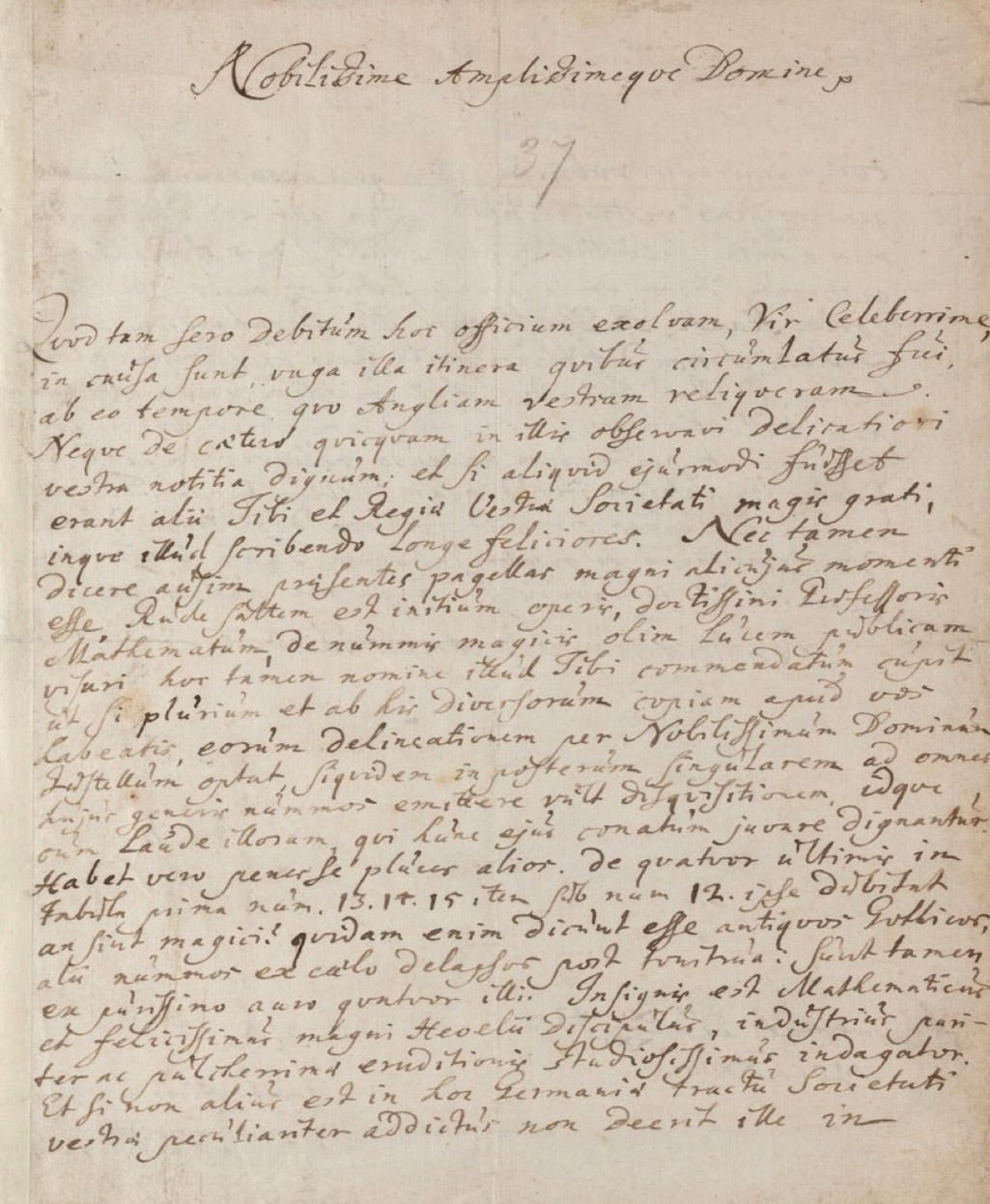
Translation:
“Most Noble and Ample Lord,
The reason I pay this long-overdue duty so late, most celebrated Sir, is due to those wandering journeys in which I have been circling around since the time I left your England. Nor did anything else occur afterward in those places worthy of being brought to your refined notice; and if there had been anything of that sort, there were others far more favored than I to write of it to you and to your Royal Society.
Nevertheless, I would not dare to say that these present pages are of great weight or of any consequence.
It is a snippet extracted from a work of a most learned mathematician, regarding magic coins, which he once desired to bring to public light. Yet on this account, he wished to commend it to you, so that if you have a greater abundance and variety of them among yourselves, he desires their illustrations through the most noble Master Lestellum, since he wishes to publish a singular treatise on all coins of this kind hereafter, and that with the help of those who deign to assist his endeavor with their light.
He holds, however, in his possession several others. Concerning the last four in the first plate, numbers 13, 14, 15, and also on page 16, number 12, he himself doubts whether they are magical.
For some say they are ancient Gothic, others that they are coins cast down from heaven after thunder.
They are, however, of the purest gold, those four. He is a distinguished mathematician, and a most felicitous disciple of the great Hevelius, a diligent investigator and a most studious pursuer of beautiful learning.
And if there is no other in this region of Germany thoroughly devoted to your Society, he will not be lacking.”
Our journey begins right here, dear reader, in a letter dated January 1, 1673.
To the untrained eye looking at the official record, this is just a piece of routine correspondence sent from John Gezelius to Henry Oldenburg, the first secretary of the Royal Society.
The establishment frames this era as the dawn of pure reason, a time when the greatest minds gathered to discard superstition and build the foundations of modern physics, math, and chemistry.
But look closer at what they were actually discussing behind closed doors.
Gezelius writes to Oldenburg to offer an extract from the work of a highly respected, distinguished mathematician, a disciple of the great astronomer Johannes Hevelius.
This wasn't a letter from a fringe lunatic; it was a dispatch from the scientific elite.
And what were these men of science cataloging?
Magic coins
The document reveals that the Royal Society wasn't just investigating the physical world; they were running a systematic audit on objects of ritual power.
Gezelius explicitly mentions that this mathematician was compiling a treatise on these occult objects and wanted to know if the Royal Society had a greater abundance and variety of them among yourselves.
They weren't burning books on the occult; they were collecting them.
The most revealing part of this first page lies in how they classified these items.
Gezelius notes that while some of these pure gold coins are suspected to be ancient Gothic, others were believed to be cast down from heaven after thunder.
The architects of our rational, modern world were sitting in their private quarters, cataloging objects of suspected celestial and magical origin, treating them not as folklore, but as data worthy of scientific inquiry.
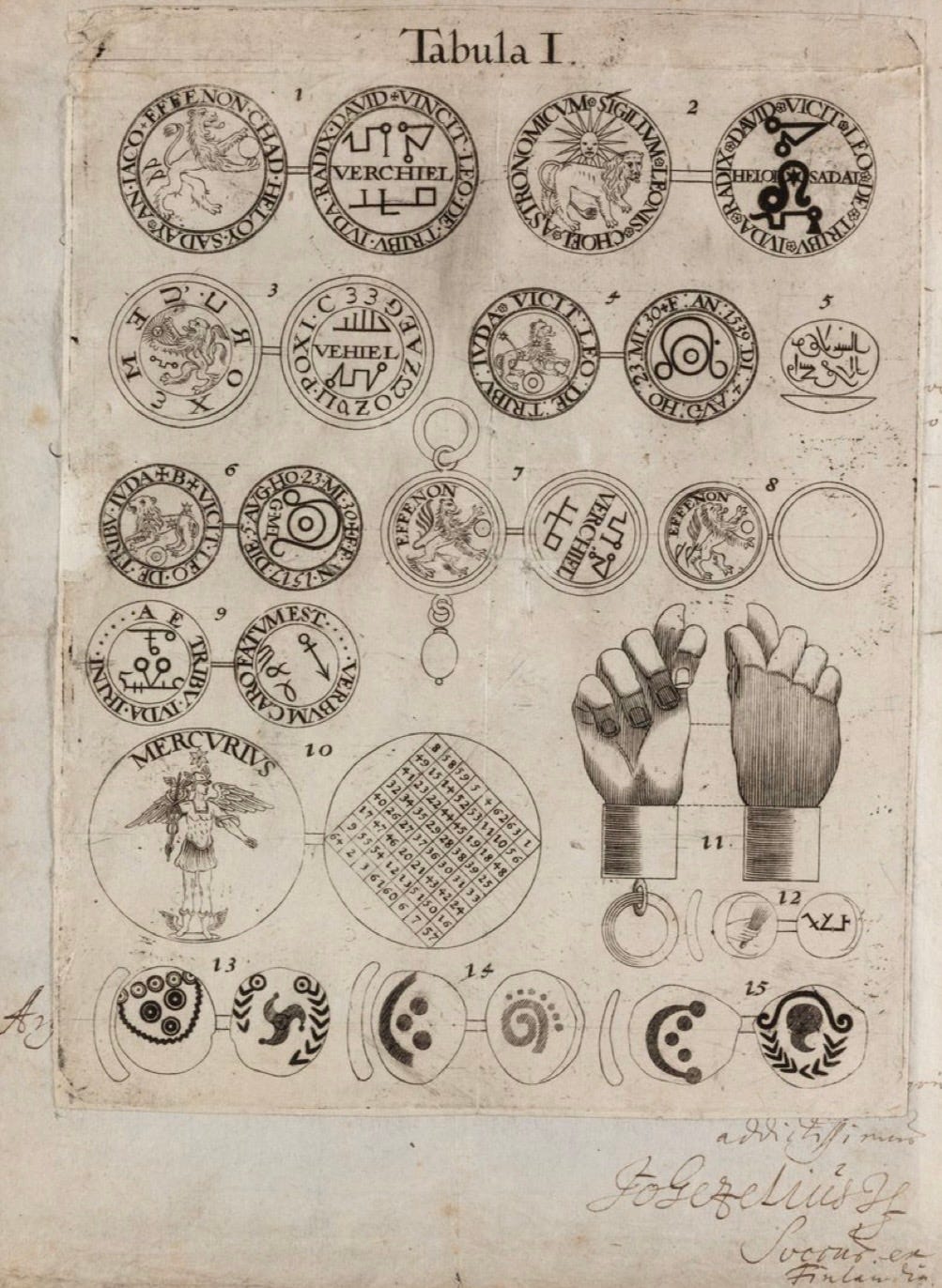
This is the visual reality they left behind, labelled simply:
Tabula I
When you look at this plate, dear reader, you are looking directly at what the founders of modern science were analysing under candle light.
It looks overwhelming, a chaotic mess of symbols and sigils, but it is actually a highly structured, mathematical blueprint for ritual magic.
Let us break down exactly what these illustrations represent, curious mind, row by row.
At the very top, numbers 1 through 4 are planetary talismans, specifically tied to the sun and the constellation of Leo.
Look at the Hebrew lettering and the specific names engraved inside the circles, like VERCHIEL.
In Western occult tradition, Verchiel is the angel ruling over the zodiac sign of Leo.
The symbols connecting the circles are not random scribbles; they are astrological sigils designed to channel specific cosmic energies into physical metal.
Row two and three continue this exact methodology.
Look closely at number 7, which shows an actual physical object, a pendant with a ring attached at the top and a droplet at the bottom.
This proves they weren't just studying abstract drawings in books; they were cataloging physical, wearable occult technology.
The sigils inside it are again tied to Verchiel, meaning this was an active amulet meant to be worn for spiritual protection or power.
Then we hit number 10, and the mathematical nature of this magic becomes undeniable.
On the left, you see the Roman god Mercurius (Mercury).
On the right, connected directly to him, is a magic square, a grid of numbers where every row, column, and diagonal adds up to the exact same constant.
In hermetic magic, Mercury governs the intellect, communication, and hidden knowledge.
The square next to him is a mathematical grid used to calculate the numerical signature of spirits.
This is why a mathematician was compiling this dossier; to these men, magic wasn't the opposite of math, it was the ultimate application of it.
Look at number 11.
It shows a pair of hands, severed at the wrist, with specific markings or bands around the fingers and base.
This refers to the Hand of Glory or specific ritual gestures used in high magic to bind or command forces.
Below it, number 12 shows a ring and a sigil meant to be engraved onto it.
Finally, look at the very bottom row, numbers 13, 14, and 15.
These are the exact four items Gezelius mentioned in his letter, the ones made of the purest gold, which he suspected might be ancient Gothic or cast down from heaven after thunder.
Notice how radically different they look from the planetary talismans above them.
They don't have Latin names or complex geometric grids.
Instead, they feature ancient, primal symbols: triskelions, spirals, and crescent dots.
These are ancient pagan amulets worn for protection long before the Royal Society existed.
The scientific elite were looking at these ancient gold artifacts and trying to decipher whether they held a raw, primordial power that fell directly from the sky.
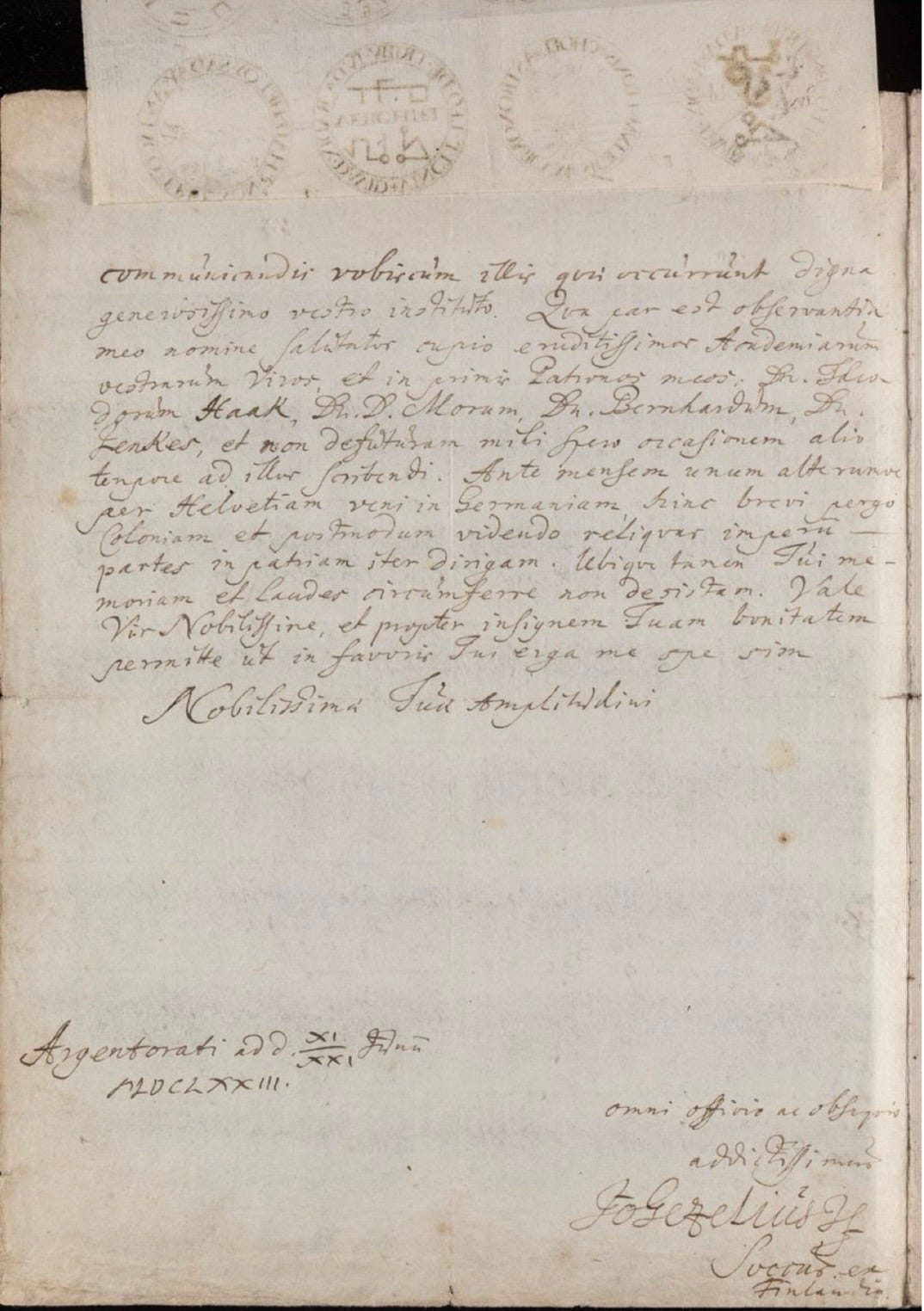
Translation:
“..to communicate with you those things which may occur, worthy of your most noble institution.
I desire that the most learned men of your Academy be greeted with due reverence in my name, and especially my patrons: Dr. Theodore Haak, Dr. D. Moram, Dr. Bernhard, Dr. Leaker; and I hope that an opportunity will not be lacking for me to write to them at another time.
A month or two ago, I came through Switzerland into Germany; from here shortly I shall proceed to Cologne, and after seeing the remaining parts of the empire, I shall direct my journey back to my homeland. Wherever I am, however, I shall not cease to carry around your memory and praises.
Farewell, Most Noble Sir, and because of your remarkable kindness, permit that I may be, in your favor toward me.
To Your Most Noble Ample Lordship.
At Strasbourg, given on the 11th/21st day of January, 1673.
Most devoted with all duty and respect,
Jo. Gezelius, Jr.
Swede, from Finland”
This page of this letter might seem like a standard sign-off, but it exposes the structural depth of this operation.
It reveals that this wasn't an isolated exchange between two eccentric individuals; it was a highly organised, international network.
Gezelius lists his direct contacts, his patrons, within the inner circle of the Royal Society.
He explicitly names Dr. Theodore Haak, Dr. D. Moram, Dr. Bernhard, and Dr. Leaker.
These weren't low-level clerks.
Theodore Haak, for instance, was one of the foundational catalysts for the Royal Society itself, a man deeply connected to the European network of invisible colleges.
By naming these individuals, Gezelius is mapping out the exact node of power within the Academy that was receiving, reviewing, and processing information regarding these magical gold pendants and mathematical sigils.
Look at the geography of the network he traces in this paragraph:
Switzerland, Germany, Cologne, and finally back to his homeland in the North
Gezelius was tracking these occult artifacts across the fractured landscape of post-Thirty Years' War Europe, acting as a field agent funnelling intelligence back to London.
The signature itself is the final piece of the puzzle:
lJo. Gezelius, Jr., Swede, from Finland
Johannes Gezelius the Younger was not a rogue occultist; he went on to become a major bishop and theologian.
This completely shatters the modern secular myth.
The very people tasked with defining the religious, political, and scientific orthodoxy of the Western world were the ones secretly auditing the mechanics of ancient magic and celestial anomalies.
They didn't view the supernatural as an outdated superstition to be mocked, they viewed it as an active, potent science to be mapped, understood, and monopolised behind closed doors.
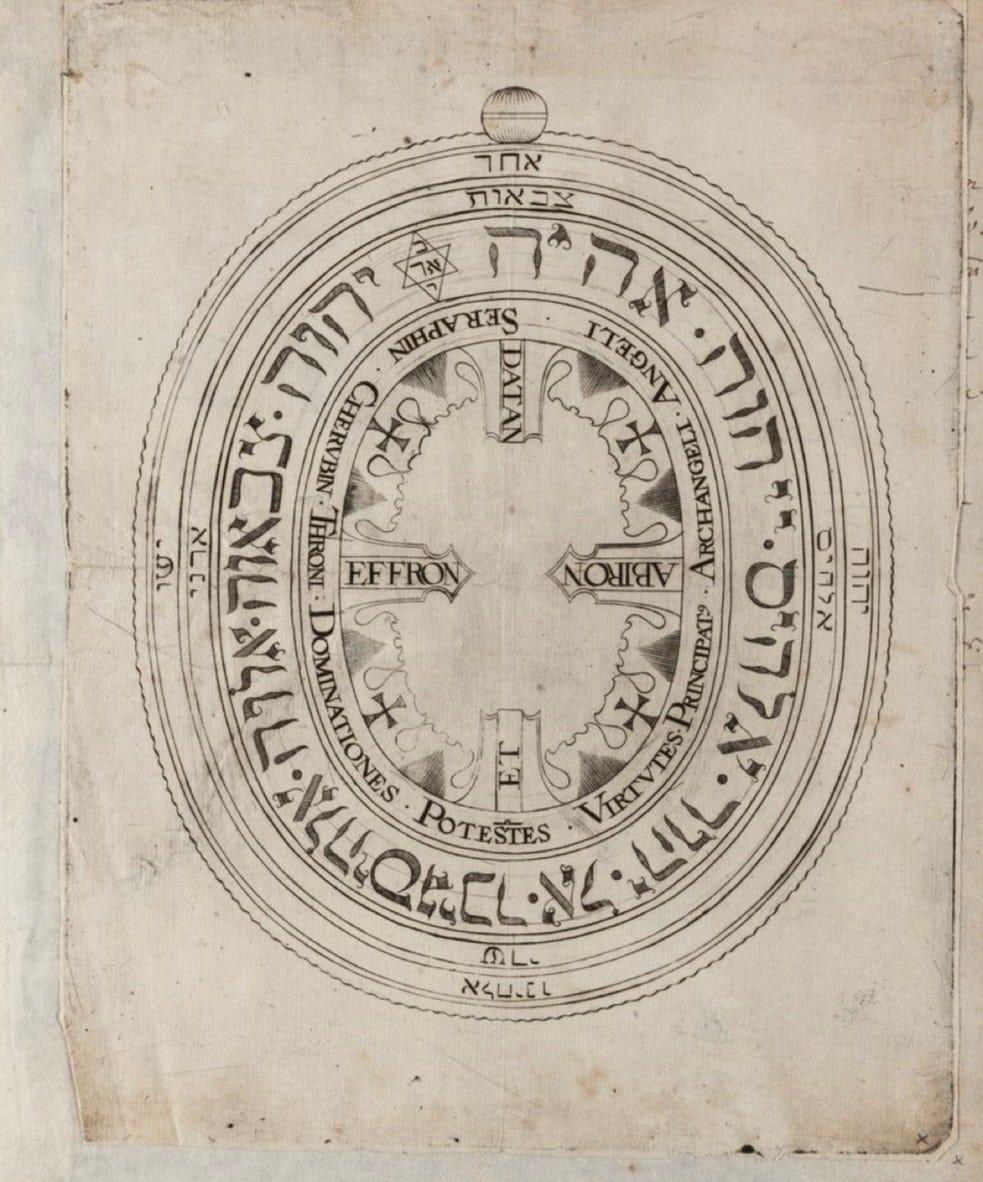
This brings us directly to the massive, concentrated engine of Solomonic High Magic that follows the letter, a visual testament to how the mathematical grid of the first plate scales up into an active spiritual mechanism.
What appears at first glance to be an intricate decorative piece is actually a protective divine talisman, specifically styled after the grand pentacles found in Renaissance grimoires like the Key of Solomon.
This was not a passive drawing for these scholars; it was a blueprint for a complex spiritual technology designed to create an unbreachable barrier between a practitioner and the entities they sought to command.
The construction of this massive symbol operates from the outside inward, starting with a small celestial globe sitting at the very top to signal that the talisman operates across the entire macrocosm.
The outermost border consists of nested rings containing powerful Hebrew names of God interspersed with specific astrological and alchemical characters.
Moving clockwise through the bold lettering, one can clearly read Ehyeh, the Tetragrammaton, and Sabaoth, flanked on the left by a prominent star containing the Hebrew letter Aleph.
In this specific tradition, geometry and language are treated as the twin pillars of creation, meaning that placing these letters within precise geometric constraints was believed to physically bind the fabric of spiritual reality.
Just inside this outer barrier of divine names, the talisman transitions into Latin script to map out the complete celestial chain of command.
It explicitly lists the classical angelic choirs, winding from the Seraphim through the angels, archangels, principalities, virtues, powers, dominions, thrones, and Cherubim.
By inscribing the names of the nine angelic orders in a literal, unbroken circle, the mathematician who drew this was constructing a spiritual perimeter shield.
The logic of the period was absolute:
no low-level entity or chaotic spirit could pierce through a boundary guarded by the entire hierarchy of heaven
The true intent of the artifact, however, is revealed at its absolute core, where a stylised cross holds the Latin names Datan, Abiron, Effron, and Et at its cardinal points.
In biblical history, Dathan and Abiram were the leaders of a famous rebellion against Moses, famously swallowed alive by the earth for their defiance of divine order.
By placing the names of these ultimate biblical rebels inside the cross, trapped at the center of the angelic perimeter, the talisman functions as a spiritual containment cell designed to bind, subjugate, and force rebellious forces to obey the will of the operator.
When the Royal Society received this letter, they were not looking at folklore; they were studying a circuit diagram of geometry, language, and theology combined to construct an active mechanism of spiritual control.
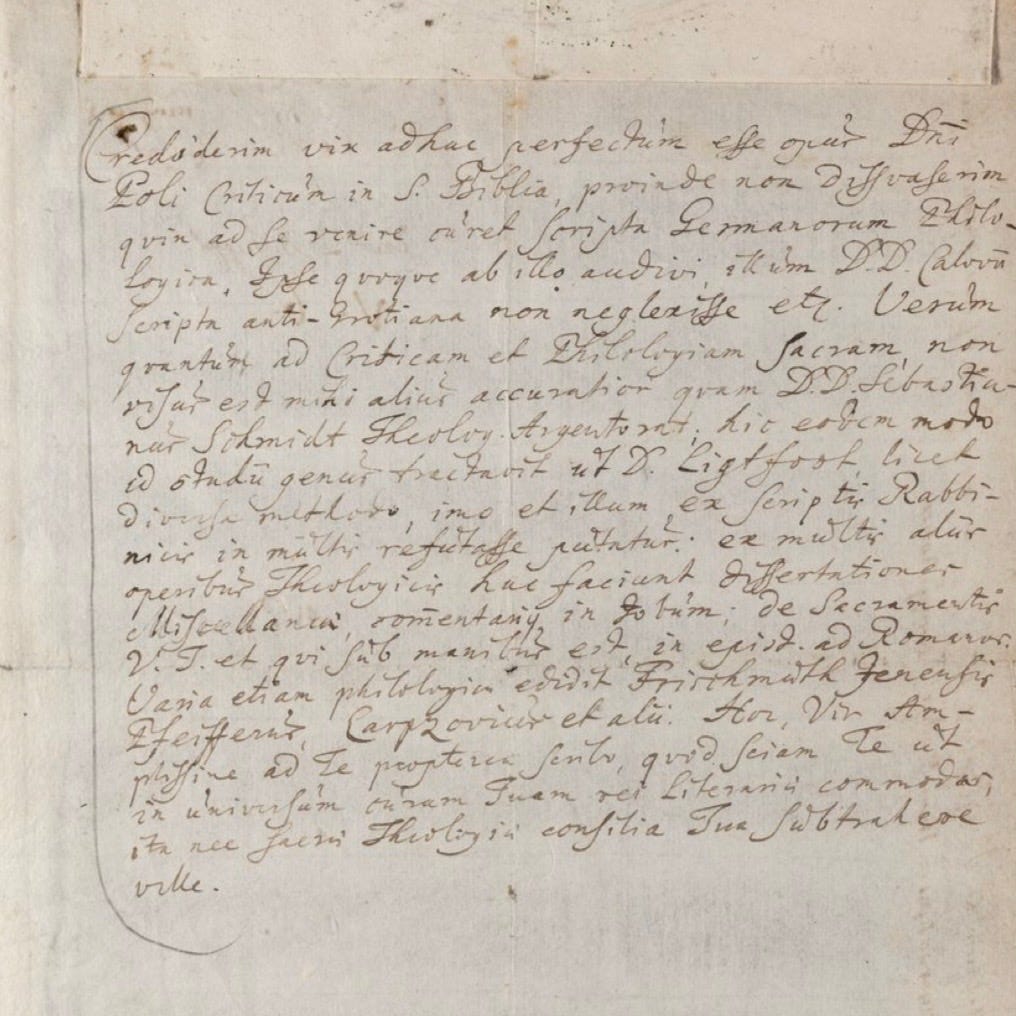
Translation:
“I would scarcely believe that what Master Poole has in his Synopsis Criticorum on the Holy Bible is as yet perfect; therefore, I would not easily dissuade anyone from drawing toward himself the philological writings of the Gemara.
I also heard from him that the same Doctor Calovius has not neglected the anti-Socinian writings, etc. But as far as Sacred Criticism and Philology are concerned, no one has appeared to me more accurate than Doctor Sebastian Schmidt, theologian of Strasbourg; he has treated this same kind of study in the same manner as Doctor Lightfoot, although by a different method, and indeed he is thought by many to have refuted that [method] from Rabbinical writings.
From many other theological works, these dissertations and miscellaneous commentaries make a whole: concerning the Sacraments of the Old Testament, and that which is under his hands, on the Epistle to the Romans. Various philological works have also been published by Frischmuth of Jena, Pfeiffer, Carpzov, and others.
These things, Most Ample Sir, I therefore send to you, because I know that just as you commend your entire care to the Republic of Letters, so you would not wish to withhold your counsels from sacred theologians.”
This textual appendix, attached directly to the back of the letter, shifts the focus from the visual mechanics of the talismans to the rigorous academic framework supporting their study.
It proves that the examination of these objects was not a disconnected, illicit hobby, but was deeply embedded in the highest levels of 17th-century biblical philology, linguistic deconstruction, and theological data-gathering.
Gezelius begins by auditing the cutting-edge academic texts of his day, pointing out that even Master Matthew Poole’s famous Synopsis Criticorum, the massive British attempt to compile all standard biblical commentary, is not yet perfect.
To fix these gaps in understanding, Gezelius explicitly argues that one must draw upon the philological writings of the Gemara, the ancient rabbinical commentaries that form the core of the Talmud.
By pushing the Royal Society to look directly at the Gemara, Gezelius is revealing the exact methodology of the network.
To decode the Hebrew divine names, angelic hierarchies, and geometric sigils seen on the grand pentacle, these scholars were not relying on medieval peasant folklore; they were treating the Hebrew language as a cosmic code that required the most advanced rabbinical tools to decipher.
He further maps out this web of specialised intelligence by citing the top structural theologians of Europe, comparing the work of Sebastian Schmidt in Strasbourg to John Lightfoot in England, and noting how Schmidt utilised specific rabbinical writings to refute or refine alternative methods.
He throws in names like Calovius, Frischmuth of Jena, Pfeiffer, and Carpzov, the intellectual heavyweights of continental academic orthodoxy.
The final lines expose the true relationship between the early scientific establishment and this sacred, esoteric research.
Gezelius writes that he sends this intelligence to London because he knows that just as Oldenburg commends his entire care to the Republic of Letters, he would never withhold his counsel from sacred theologians.
The Republic of Letters was the global, borderless network of scholars that birthed modern science, and here it is shown working hand-in-hand with the men mapping the supernatural.
They were treating biblical analysis, ancient linguistics, and ritual magic as branches of the exact same data-driven tree, utilising an international network of academic elites to systematically master both the physical and the spiritual architectures of the world.
And so, dear reader, we must reflect on this rather provocative letter.
We must stand back from the ink and the parchment, away from the geometric precision of the sigils and the cold Latin names of long-dead scholars, and look at the vast, unsettling horizon this document opens before us.
What we have pulled from the silent depths of the archive is not a historical curiosity; it is a fracture in the carefully constructed glass floor of our modern reality.
We are told, from the moment we are old enough to sit in rows and receive our inheritance of standardised thoughts, that the story of humanity is a neat, linear march out of the dark, trembling waters of superstition and into the sterile, reliable light of purely physical reason.
We are taught to look back at the seventeenth century as the triumphant moment the scalpel separated the soul from the synapse, when the cosmos was safely reduced to a clockwork machine of gears, gravity, and predictable matter.
Yet here, tucked away in the very files meant to catalog that secular dawn, lies the undeniable proof of a shadow empire.
What this letter shows us, with a devastating clarity, is that the high priests of our modern materialist paradigm never actually believed the simple story they sold to the masses.
While they were building the public walls of the rational world, they were privately sitting in the dark, measuring the dimensions of the supernatural with the exact same rulers they used to calculate the orbits of the planets.
They did not banish the divine, the angelic, or the ancient currents of the earth; they just built a fence around them and claimed the exclusive right to walk the perimeter.
To look upon the grand Solomonic pentacle, preserved in the records of the world's premier scientific academy, is to realise that the birth of modern science was not an eviction of the spiritual, but an audit.
It was a systematic effort by an international elite to catalog, control, and monopolise the invisible architectures of creation.
The weight behind this realisation is heavy enough to alter the gravity of how we live our lives today.
It means that the profound sense of isolation so many independent minds feel in the modern era, the haunting intuition that our contemporary world is flat, hollowed-out, and strangely artificial, is entirely justified.
The world feels artificial because it was designed to be.
The public was fed a version of reality stripped of its depth, a two-dimensional map that keeps the eyes locked firmly on the ground, consuming, working, and drifting through a gray landscape of pure materialism.
Meanwhile, the true nature of reality, with all its terrifying cosmic heights and hidden mathematical symmetries, was treated as classified data, reserved only for those who held the keys to the Republic of Letters.
They knew that language, geometry, and spirit were inextricably bound; they understood that to master the physical world, one had to master the unseen currents that breathe life into it.
This matters, ultimately, because it restores our right to wonder.
It breaks the spell of a world that tells you that anything you cannot touch, monetise, or measure with a corporate instrument does not exist.
This letter is a message in a bottle from the very architects of the modern cage, inadvertently admitting that the cage has an open top.
It proves that the boundary between the sacred and the scientific, between the ancient magic cast down from the thunder and the sharpest mathematical intellect, is an illusion maintained to keep us passive.
When we look at these documents, the historical narrative doesn't just bend; it shatters, and in that shattering, we are given a rare, priceless gift:
the validation of our own intellect
We are reminded that to seek the truth, to refuse the sterilised fables of the establishment, and to look into the shadows with a spirit of deep, uncorrupted reverence is not an act of madness.
It is the continuation of an ancient, fiercely guarded human duty.
The truth was never truly hidden in a locked vault; it was simply left out in the open for anyone with the stillness of soul, the depth of frequency, and the courage of mind to look.
Should you ever feel moved to support this endeavor financially, know with absolute certainty that it is never a requirement.
In a world that seeks to commodify every breath and every breakthrough, your presence here, your uncorrupted curiosity, and the stillness of your attention are the highest currencies imaginable; they are valued far above anything that can be counted in coin.
However, for those who wish to extend a hand to keep this machinery moving, any funds contributed are channeled directly back into the excavation itself.
They go toward the procurement of rare, out-of-print literature, the securing of specialised archival access, and the physical resources required to pull these buried truths out from the shadows of forgotten libraries.
Thank you, dear reader.
X-Files is probably my favorite TV show ever. All of those "paranormal" themed shows. These days I have time to follow up on those mysteries. Cheers & thanks as always for the stimulating revelations.
I appreciate your articles, my friend. You and I are like Soul Brothers!
I deeply respect those who go directly to primary sources rather than passively accepting interpretations from others, all of whom naturally bring their own assumptions and biases to the table.
There’s something special about digging through old books, forgotten texts, and original records to piece together history for yourself.
And now, with AI, the game has changed entirely. You can effectively build a research companion to help analyze, cross-reference, summarize, and uncover connections that might otherwise take months or years to find.
Really enjoying your work. Keep it coming.